GTX 2026
16 Mar 2026
GTX 2026
Subscribe to CX E-News
Group Technologies and L-Acoustics unveil Southern Hemisphere’s first L-ISA Auditorium
Group Technologies’ in-house GTX trade event is always an excellent opportunity to network, catch up with developments in tech, and chat to the many international visitors representing their brands. Back after a year’s hiatus, there were even more reasons to get to GT HQ on 25 February, including the big debut of L-Acoustics with the distributor.
The French PA manufacturer is known globally for the slick presentation of its products, with their demos and presentations harmonised and tightly on message. Part of this strategy includes a network of dedicated spaces for people to experience and work with their L-ISA spatialisation and acoustic enhancement system, dubbed L-ISA Auditorium. They’re found across the world, and now for the first time, in Australia.
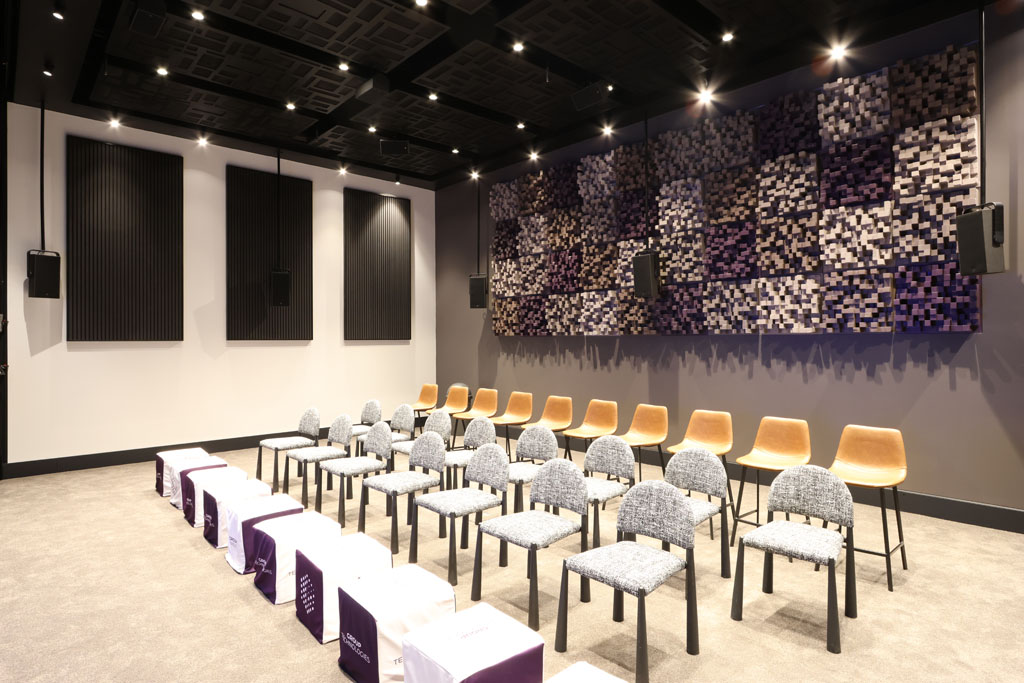
Group Technologies transformed an existing demonstration space at their Melbourne home over the course of four months, starting work almost immediately after taking on the distributorship. The result, with the opening celebrated at GTX, is a world-class facility that is perfect to evangelise the technology to all parts of the industry, including venue operators, artists, and producers, as well as technicians.
I came along to a scheduled L-ISA demo at GTX having been warned to get there 15 minutes early, as they were all packed to capacity. Lucky I did, because with five minutes before showtime, they were having to turn people away and tell them to come to the next one. While I have experienced L-ISA many times before, I haven’t heard it in such a beautifully acoustically treated room.
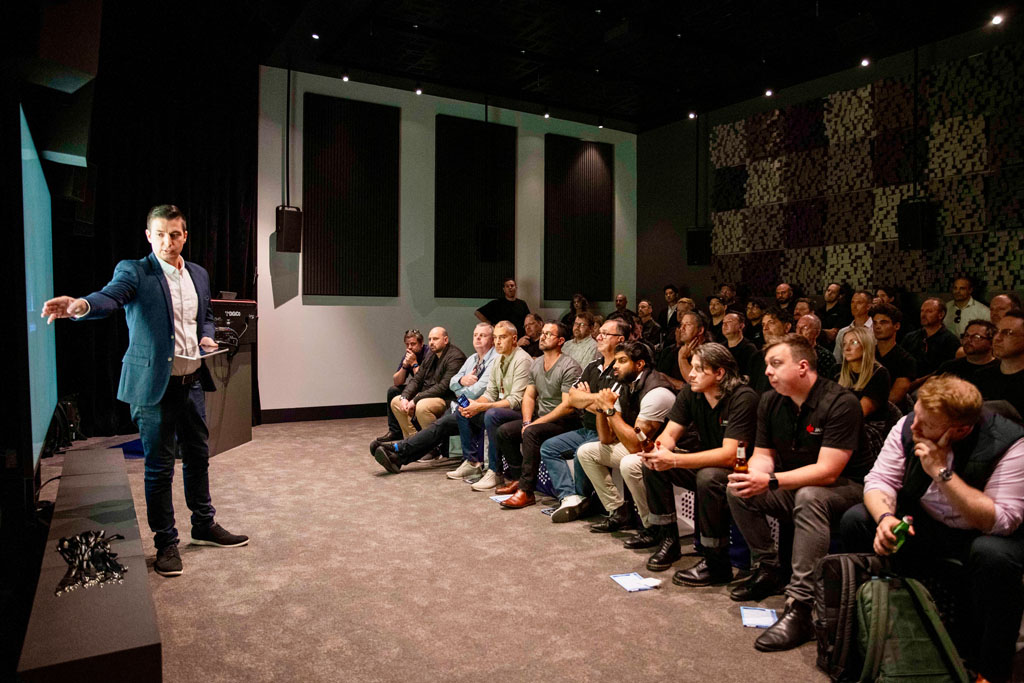
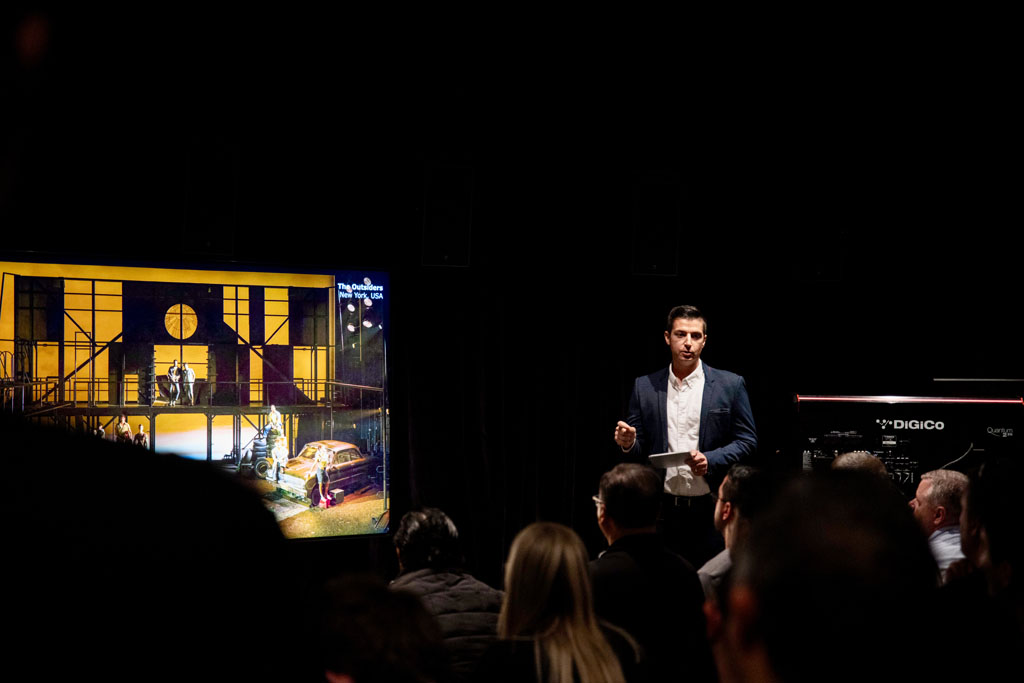
The demo started by going pitch black and playing a live recording of the LA Philharmonic performing a Harry Potter overture, spatialised with L-ISA Hyperreal, their frontal localization system. It was like being in front of a live orchestra. Other highlights included a soundscape that L-Acoustic’s Daniel Lee put together on his laptop using headphones on the plane ride over from Singapore, using binaural mixing software L-ISA Studio. The finale was a live recording of British singer-songwriter Raye performing at London’s Albert Hall with a full orchestra, which was mixed on L-ISA Hyperreal, showcasing just how big GT’s L-ISA Auditorium can go.
Perhaps the most subtle yet powerful moment of the presentation came near the end, when the L-Acoustics staff explained that the acoustic enhancement system Ambiance had been active during their presentations, with microphones in the ceiling picking up their voices and L-ISA adjusting the volume and reverberation. They then turned it off, the room went completely dead, and they kept speaking. What had been a pleasant natural volume of speech dropped to an unworkable level. To make the point, they turned it on and off a couple of times, and increased the size of the room. People actually gasped, because your brain really struggles when what you are hearing and what you are seeing don’t agree with each other.
After that thoroughly enjoyable 30-minute experience, I sat down with five of the six L-Acoustics staff present at GTX to talk about the L-ISA Auditorium, and the global strategy to expand L-ISA’s use in both venues and live production.
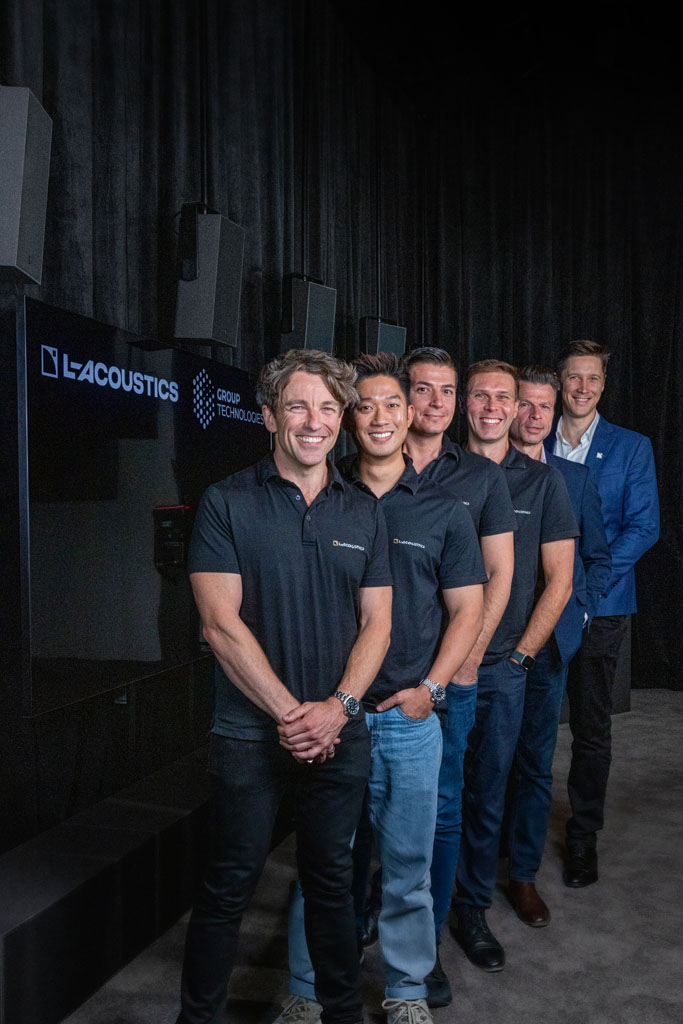
THE L-ACOUSTICS TEAM AT GTX 2026
(L-R) ROY CRESSEY, DANIEL LEE, CHRIS D’BAIS, DAMIEN JUHASZ, DAVID COOPER, AND SEBASTIAN HAMMOND
“We have two L-ISA Processor IIs in this room,” explains Damien Juhasz, Consultant Liaison, APAC. “One for the object-based processing of frontal localisation system Hyperreal and object-oriented surround mixing system Immersive, and one to run Ambiance, our acoustic enhancement system; it’s two different firmware versions.”
All of the loudspeakers in the Auditorium are from L-Acoustics’ point source X Series. “We’ve got seven X8is across the front, and seven X8is as lateral surrounds both side and rear,” continues Damien. “Then there are 10 S6i overheads, plus four Syva Subs. We’re driving this all off two 16-channel LA7.16i amplified controllers, with signal on an AVB backbone. That’s 2RU powering the whole room; it’s very cost effective.”
“The design process of this L-ISA Auditorium was a collaborative approach between L-Acoustics and GT,” says Chris D’bais, Regional Sales Manager. “We went back and forth with different room designs, but ultimately chose this to make it consistent with the L-ISA Auditoriums that we’re deploying globally. The great thing with GT was they were open to anything that we wanted to achieve. Then they took our design and all our documentation, and then they built this. They pulled all the cable in, built the room, and put everything together.”
The opening of the Auditorium comes at a time when L-ISA use in Australia is expanding dramatically. Two existing L-ISA installations at St Michael’s Grammar School in Melbourne and Sydney Coliseum have just been joined by a whopping four at Perth’s new Edith Cowan University (ECU) city campus, home of the Western Australian Academy of Performing Arts.
“There’s eight venues at ECU with L-Acoustics PAs, and four of them are L-ISA, including a spatial audio studio,” continues Chris. “L-Acoustics wants to partner with educators long-term, so we can see their students go into the field after their studies already knowing L-ISA technology. One of the things that was really important for us, particularly with this room and ECU, was making sure that people have a space to create. We’ve identified that front of house engineers and creatives need space to have a console and program their show before they go into a venue. Now artists and engineers can use the L-ISA Studio binaural software on their DAWs in their own space, then move into this room. It’s a really good workflow to enable people to get into L-ISA for their shows.”
The democratisation of access to L-ISA via the free L-ISA Studio software is definitely helping with adoption. “ECU are really excited about L-ISA Studio,” says Perth’s own Roy Cressey, Regional Application Engineer. “They’ve got a large volume of students that can be at home working on L-ISA Studio on headphones, getting a substantial amount of their programming done. They can then take their designs into the theatres, where time’s more limited and needs to be booked into advance. That’s a really big value add for ECU’s scheduling.”
Daniel Lee, L-ISA Applications Engineer based in Singapore, helped calibrate the Auditorium and customise demo content for the facility. Having worked across APAC, he’s seen first-hand how L-ISA is taking off overseas; “Some of the more notable L-ISA applications in APAC are big installations, like a recently completed 5,000 seat house of worship in Singapore with our new L2 line array,” he relates. “There are a number of bigger L-ISA venues across China as well. What really excites me is how L-ISA is being used to enhance the live music experience, even outdoors. There’s a lot of understanding in the market now that L-ISA enhances the listening experience. It’s now about trying to work out the workflow; how do we get from pre-production to the stage? L-ISA Studio is the first point of entry for artists and musicians, then we can move on to rehearsal spaces, and then finally to the live venues.”
“We’ve seen a lot of interest in post-production studios and record labels who are recording artists in Dolby Atmos for Apple Music,” adds Chris D’bais. “Audiences are listening to it, and then they’re going to concerts that are in stereo, which is often just dual mono. They’re identifying a disconnect, but they don’t know why. The record labels are approaching us asking how they can take something from studio into the live world, and we’re focusing on how to bridge that gap.”
“I think that the big uptake in live shows using L-ISA, particularly in China, has been a direct result of the availability of L-ISA Auditoriums and studios,” observes Damien Juhasz. “It’s very hard to convince stakeholders in the live production game to make the leap into immersive without them having the experience of hearing it first. If you can bring an artist, promoter, and engineer into an L-ISA space like this one at GT, let them bring their own tracks and show them how easy it is to use, that’s what convinces the decision makers to get it over the line and take it out on the road.”
“We’re really excited about the journey ahead with Group Technologies,” declares Sebastian Hammond, Director of Application for APAC. “They’ve been in the business a long time, and it’s clear that they have a vision as to how they represent their products. The facility that they’ve got here is just unbelievable; it’s beautiful, and we couldn’t ask for a better space. We can talk all we want about the technology, but getting an audience in front of the system is the most influential thing we can do.”
“Material costs on projects in Australia are going up,” concludes Chris D’bais. “People still want a multi-purpose venue, but often can’t afford it. Now they’re looking for alternatives, particularly with L-ISA and Ambiance, so they can present everything from spoken word all the way up to opera. This is where we can offer that full solution from start to end. This room is about selling the dream of what your venue could be.”
Following on from my conversation with L-Acoustics, I chatted to Anthony Touma, General Manager of Group Technologies, about their experience of onboarding with L-Acoustics and the process of the building the Auditorium.
“The concept of the Auditorium was completely in line with how we present to the market, and how we deliver our brands to customers,” says Anthony. “We had the space to set up a dedicated room, and the technical expertise to build it in-house. It was a natural progression for us, and we built a very sophisticated room together inside of four months. I am so proud of the team’s accomplishment on that front, and it’s exciting for us to share such innovative technology with our industry.”
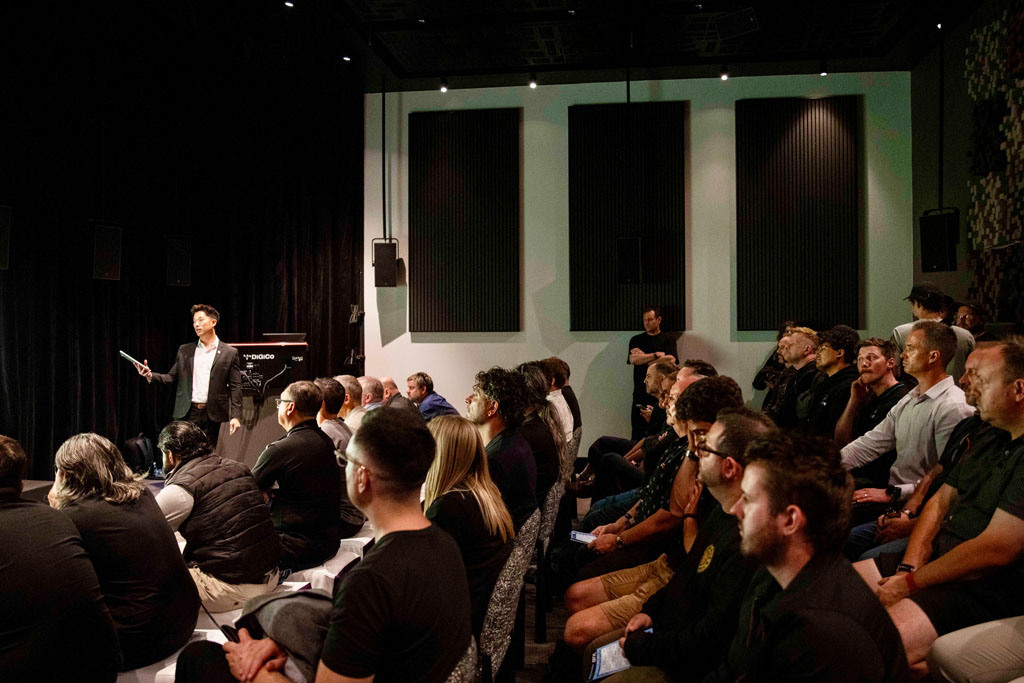
L-ACOUSTICS’ DANIEL LEE PRESENTS L-ISA IN THE L-ISA AUDITORIUM. PHOTO CREDIT: MELISSA BUTTERS
While only officially opening at GTX, there was already a buzz in the air around the facility. “We have theatrical sound designers, engineering consultants, content creators, progressive producers, and production customers expressing interest in coming in and working in the L-ISA Auditorium,” divulges Anthony. “They’re trying to understand how they can place immersive systems in front of their customers and how it’s relevant in their markets.”
While Ambiance and Immersive are more likely to be used in fixed installations, the Hyperreal frontal system is gaining traction in live production. “There’s a lot of live L-ISA Hyperreal frontal productions in the works, because it is becoming more and more common overseas,” explains Anthony. “L-Acoustics are the most developed in that space, having the wider image and sweet-spot across the listening plane, creating a better experience for live concerts. Hyperreal is also gaining a lot of traction in the worship market, particularly with large format L-ISA installations around the world.”
“L-Acoustics’ technical knowledge and support is second to none,” concludes Anthony. “All of their staff are so passionate, experienced, and responsive. Working with them doesn’t feel like we’re just ticking boxes and meeting standards, it feels like we are working together to get the best possible outcome. Going forward, L-Acoustics and GT are going to be working very, very closely; more closely than most manufacturers work with distributors. We want to be a genuine extension of the manufacturer. We have never been a box-moving distributor. We’re focused on providing best in class solutions and backing them up with comprehensive support. GT has always prided itself on developing longstanding partnerships and we’re looking forward to representing L-Acoustics in a totally new way throughout ANZ.”
—
Main Pic: THE L-ISA AUDITORIUM
Subscribe
Published monthly since 1991, our famous AV industry magazine is free for download or pay for print. Subscribers also receive CX News, our free weekly email with the latest industry news and jobs.
Recent posts


Latest jobs