News
2 Oct 2026
Apparently I May Not Be Too Deaf to Mix After All

Subscribe to CX E-News
I recently had my hearing tested. The result explains quite a lot for my beloved Kate, who spent most of our holiday saying the same thing twice or thrice!
My audiogram runs roughly from 125 Hz at the left to 8,000 Hz at the right. Zero dB on this particular scale doesn’t mean silence; it represents the hearing threshold expected from a young person with undamaged hearing. They should have a line along zero in the purple (top) quadrant. My lines wander rather enthusiastically away from that ideal.
The really important territory is the ‘intelligibility’ middle, around 1,000 hertz (1 kHz) and up to 2 kHz, where much of the information that makes speech intelligible lives. I have one reasonably good ear and one considerably less impressive example there. At the top end, things head way down south.
Which, I had assumed, was one reason I stopped mixing bands. The other reason was contempt: whilst a professional band always has my respect, when a bunch of older blokes turn up with brand new uber-expensive gear and start murdering ‘Oz Rawk Classics’, my guts churn. More on these jerks later.
I’ve known for years that my hearing was declining. When mixing, I consciously tapered my top end because I knew I wasn’t hearing it as well as the audience. Some older sound engineers don’t make that allowance. They keep winding more HF into the PA until they can hear it. I recall a series of mainline gigs that actually HURT my hearing, and they were back a decade or three when things were not so dire in my ears.
If the PA is peeling your face off at 4 kHz, there’s at least a possibility the guy behind the console has been doing this for 40 years. He (never a she, they are more considerate) really should know better.
I also have magnificent full-blown tinnitus. My brain has largely incorporated it into normality, but tinnitus can be absolutely debilitating for other people. It can drive people to self-harm.
Looking at my audiogram, my conclusion was straightforward: time for hearing aids and definitely no return to mixing bands. Then my wise old audio colleague Rik van der Velde threw a rather interesting spanner into the works.
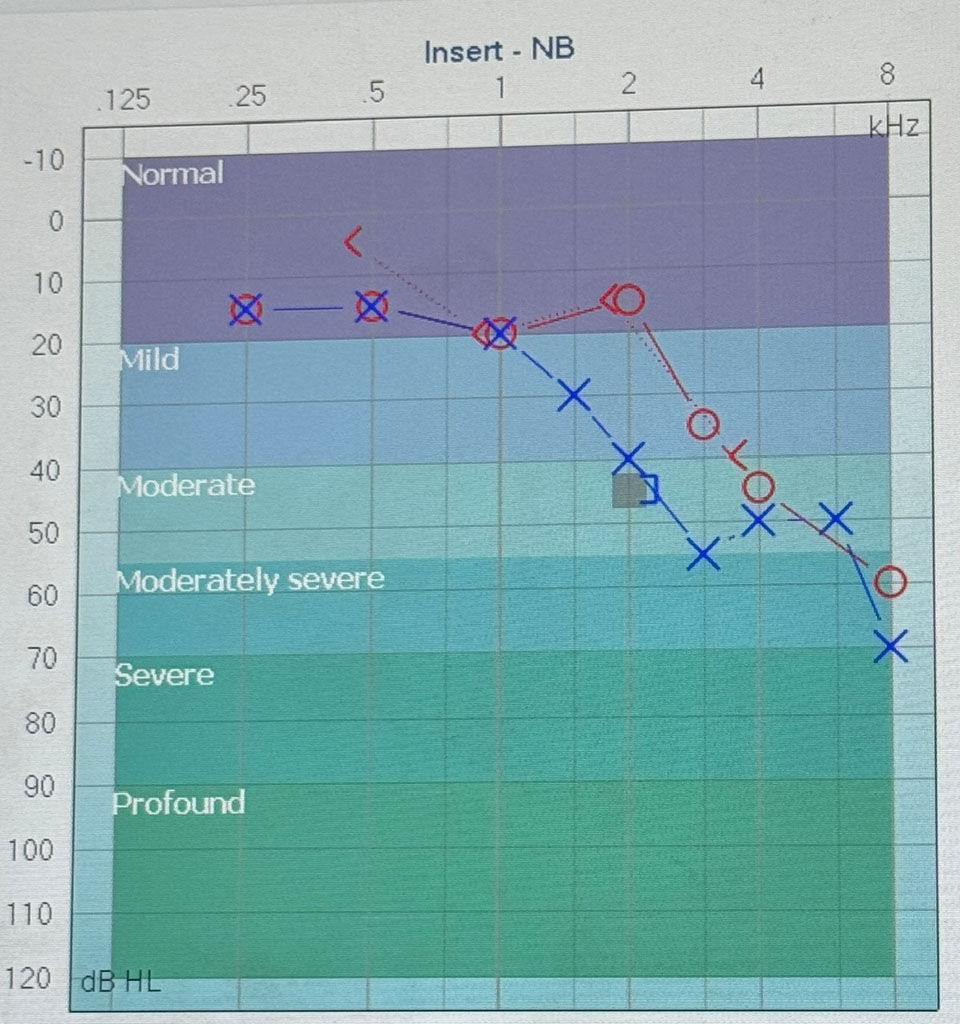
Rik suggested that an audiogram doesn’t actually tell the whole story. It measures the threshold at which you can first hear a frequency. It doesn’t necessarily tell you what happens to your hearing when the sound gets loud.
There is a well-established phenomenon called loudness recruitment. With some forms of cochlear hearing loss, particularly involving the outer hair cells, sensitivity to quiet sounds is reduced dramatically. But as the sound level rises, perceived loudness can catch up surprisingly rapidly. Someone might need considerably more level than a young listener simply to detect a high-frequency tone, yet at 85 or 90 dB the difference between them can be much smaller. Research has demonstrated precisely this sort of convergence at higher sound-pressure levels.
In other words, the audiogram says, “Julius can’t hear this quiet sound”, but it does not necessarily say, “Julius can’t hear this frequency when the PA is doing 95 dB.”
That’s a rather important distinction for a live sound engineer.
So I conducted a very crude experiment. I ran a frequency sweep at decent volume. Despite the alarming downward slope on my audiogram, I could clearly discern the sweep out to about 10 kHz, after which it rolled away.
It doesn’t prove that my loud hearing is normal, nor does it mean I should rush out and mix Metallica, much as I’d love to. A proper investigation would measure not merely my hearing threshold but my loudness growth and comfortable/uncomfortable listening levels at different frequencies. And deliberately turning test tones up until they hurt is a particularly dumb DIY experiment for somebody who already has hearing damage and tinnitus.
But Rik’s underlying observation totes checks out. Audiologists call the difference between your threshold of hearing and the point where sound becomes uncomfortably loud for your dynamic range. Cochlear hearing loss can squeeze that range dramatically: the bottom moves upwards while the top moves much less.
Now the uncomfortable BAD BAND implication. For decades I have occasionally stood at front of house listening to what was coming off stage and thought: This band is terrible. Being generally nice (although famously blunt and/or tactless), I would sometimes ask the offending Dad Band when they had last properly rehearsed. Not “had a session at Bill’s home studio with beer and bongs.”
“Like, really rehearsed: timing, harmonies, arrangements, starts, stops, playing together.” You know the scenario, a band made up of lawyers, accountants, real-estate agents or CFOs carrying $40,000 worth of shiny new instruments, before inflicting a horrible playlist upon us culminating inevitably in April Sun in Cuba or Am I Ever Gonna See Your Face Again. The pain. The horror.
Now Rik has given me the possibility of a defence. Perhaps at proper live-music levels my hearing isn’t quite as decrepit as my audiogram makes it look. And those bands really are/were that bad.
I’m going with that. But I’m still getting the hearing aids. On a final note, there is an ‘association’ with dementia. The 2024 Lancet Commission’s analysis found people with hearing loss had about a 37% higher rate of subsequent dementia than those without, although the researchers stress that the mechanism isn’t settled. Having struggled to understand what my lovely is saying to me, I completely agree.
—
Main Photo By @Philhearing On Unsplash
Subscribe
Published monthly since 1991, our famous AV industry magazine is free for download or pay for print. Subscribers also receive CX News, our free weekly email with the latest industry news and jobs.
Recent posts