By the People, For the People.
19 Oct 2026
Integrate 2026

Subscribe to CX E-News
The People Have Spoken!
When we got to Integrate 2026 at Sydney’s ICC on 2 September, we’d already decided that this year we’d be covering the show differently.
For the last few years at trade shows, both domestic and international, the trade media have fallen into the trap of all creating the same coverage, and we’ve been just as guilty. The pattern goes like this:
We all turn up with camera rigs of varying types and sizes. There are about eight of us at Integrate, but up to 50 or more at international shows.
Everyone then proceeds to interview the same product specialists about the same products. The specialists give the same spiel to all of us, which is the same spiel they will give to prospective customers over the next few days. We all then place this on our websites, YouTube pages and socials. Now there are anywhere between eight and 50 versions of the same video on the web.
Boring!
So, we decided we didn’t want to hear from a single manufacturer, distributor, product expert or salesperson. For a start, we know what they’re going to say – that their product is great! Instead, we’ve taken the same methodology we use for our CX ‘Road Test’ product reviews – the opinions of real professionals, who work in our industry with their reputation and livelihood on the line every day.
So here we have ‘Integrate – By the People, For the People’. We’ve put together a short, hyperbole-free description of the product from the manufacturer for context, followed by the live on-the-show-floor impressions and comments from you, the technical public.
Our Impressions of the Show
Of course, everyone asks ‘what did you see? Anything good?’ As editor, I’ve made a captain’s call to include what caught my eye, and you’ll find it on page 55 (linked here).
I would also typify the 2026 show as one of those years where there’s not a lot of radically new tech, just mainly incremental improvements on previous products.
One of the only really interesting new developments is comms that use 5G cellular networks, either public or BYO. Both Clear-Com and Green-GO had products on show that do this, and Riedel released one last year. You can find Clear-Com right next to this intro, and Green-GO back on page 20, in our ‘New Gear’ section.
—
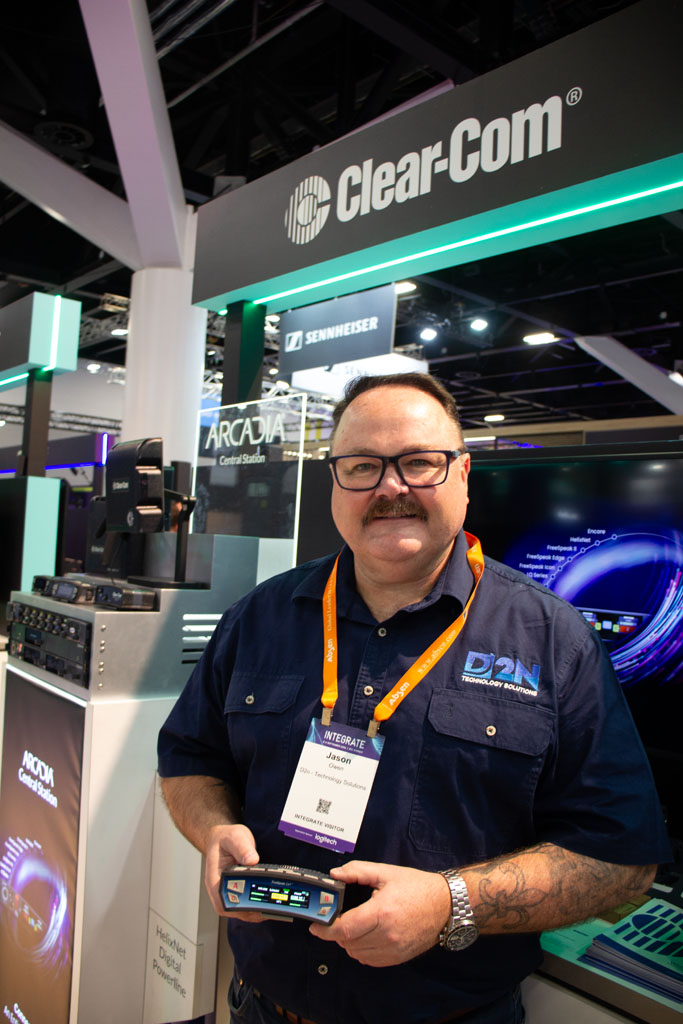
CLEAR-COM FREESPEAK CELL
FreeSpeak Cell operates over 4G LTE/5G cellular networks, eliminating reliance on crowded or restricted RF spectrum. By using private LTE or carrier-grade cellular infrastructure, FreeSpeak Cell avoids the coordination challenges, interference risks, and deployment complexity associated with traditional wireless intercom frequencies.
Unlike RF-based wireless intercom systems that require strategically placed transceivers, FreeSpeak Cell enables roaming wherever cellular coverage exists. This allows teams to move freely across large venues, campuses, or sites without installing, cabling, or maintaining antenna networks.
Cellular networks are designed to support high device counts. FreeSpeak Cell takes advantage of this capability to support hundreds of beltpack users in a single deployment (network-dependent), making it ideal for large productions, operations teams, and multi-department environments.
Jason Owen, Owner, D2N Technology Solutions:
“We’re not afraid of innovation and adding extra kit to our inventory that we can use across multiple customers. We see FreeSpeak Cell as a real game changer in terms of offering full-duplex high-bandwidth communications, not just for our AV and broadcast customers, but also for our motorsport customers. In motorsport, it’s a huge advantage not to have to add antennas around a racetrack and along pit lanes. That’s an exciting use case for us.”
—
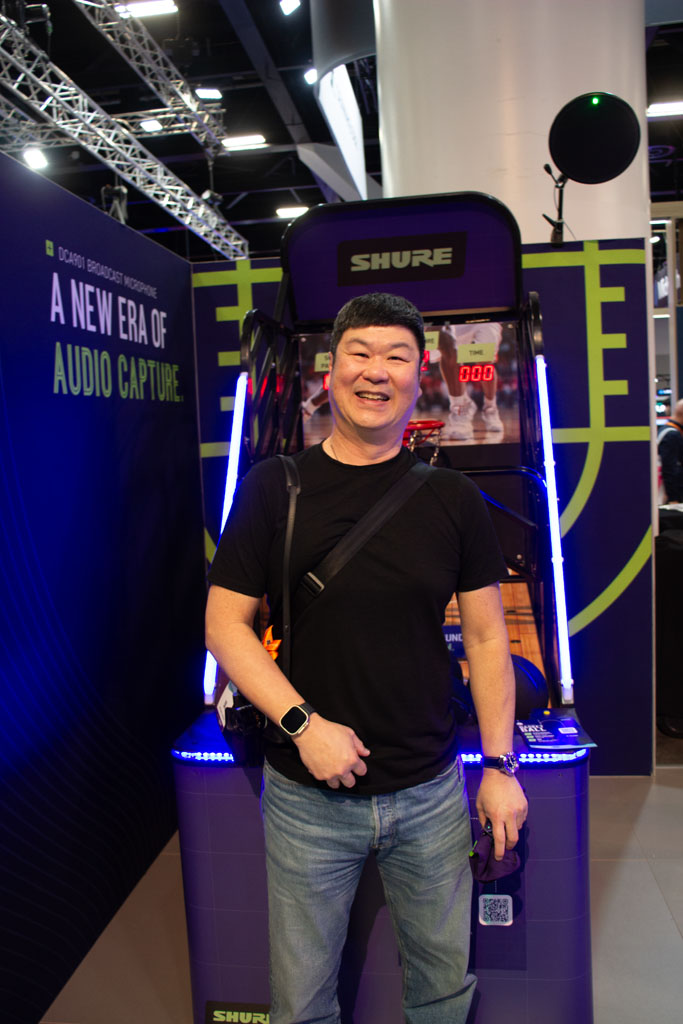
SHURE DCA901
The DCA901 opens new possibilities for capturing sound in broadcast and media production. This compact digital broadcast microphone array delivers eight channels of high-fidelity audio through a single network cable. Steerable pickup zones isolate the sounds that matter while minimising ambient noise. With built-in DSP, fewer cables, and faster setup, it replaces bulky analog systems while supporting experiential, story-driven sound and modern production workflows.
Steerable lobes isolate the zones you want, minimising ambient off-axis noise. Use Auto Position to quickly orient the lobe in your desired direction. One network cable carries audio, power, and control, simplifying routing and reducing risk. Internal DSP handles EQ, compression, delay, and automixing, reducing hardware needs and giving you more time to focus on sound design. Save and recall presets to deploy faster and maintain consistency across broadcasts, venues, or events.
Kheong Sen Lim, RDK Consultants:
“Why didn’t someone develop this 10 years ago? This replaces a bunch of shotgun microphones on the sidelines at a sporting event. It’s low-profile, it’s slim, you can mount it on a wall or fence, and you won’t get players running into it or tripping over mics on low stands.
The most impressive features are its low profile, eight zones, PoE, and Dante. It replaces several microphone positions with less cabling and less hassle. I would absolutely specify the DCA901.”
—
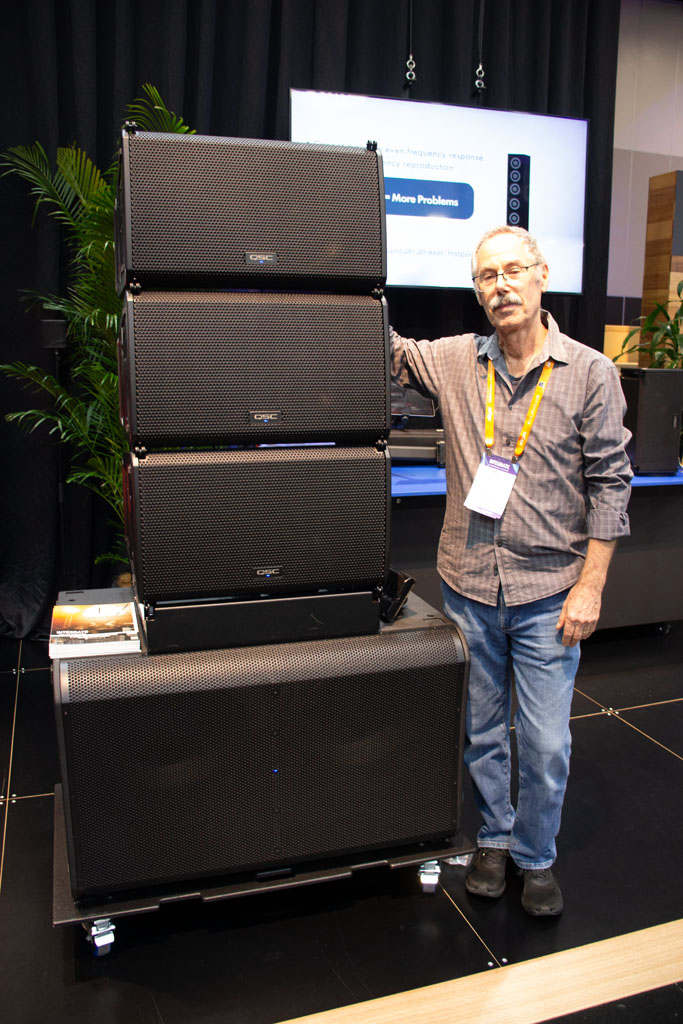
QSC L-CLASS
L Class line array elements and subwoofers represent the next generation of advanced, intelligent, active loudspeakers for applications ranging from simple, portable, plug-and-play setups, to demanding, networked, high-tech AV productions and fixed installations.
L Class delivers exceptional performance and an exceptional audio experience via high-output amplification, state-of-the-art DSP, premium components, extensive system intelligence and an elegantly intuitive interface.
L Class also sets a new standard for ease of use, as its users will be able to confidently configure and deploy any L Class system with unmatched speed and reliability. Onboard Dante connects L Class to networked AV systems and connected stages.
L Class comprises the LA108 and LA112 powered line array elements, fitted with 8” and 12” woofers respectively, and the LS118 single 18” and LS218 dual 18” powered subwoofers.
Don Goldstein, Live Sound Dept Manager, Turramurra Music Centre:
“Sydney’s Pymble Ladies’ College came to us interested in a portable PA system that they could use out in a grassy area or in their gymnasium. My thinking to meet their requirements was along the lines of efficiency, ease of use, and how they would move things in and out. I first designed a system based on a cart that could be rolled in and out of the gymnasium and lifted up. I arranged some QSC L-Class demo gear for them to try out, and they fell in love with it. Then the scope of the work changed, and they decided to make it a permanent install.
The college wanted a simple, easy solution, and L-Class is very simple to use. A single cable hooks everything up; they just run Dante from their mixing desk. They’re taking inputs from a Sennheiser EW-DX four-channel Dante receiver. Everything is being run via Dante, set up on an app, and quite easy for them to use. They’ve got four hangs with six speakers over two different basketball courts, so they can switch one off if they need to, and they love the way the system sounds.”
—
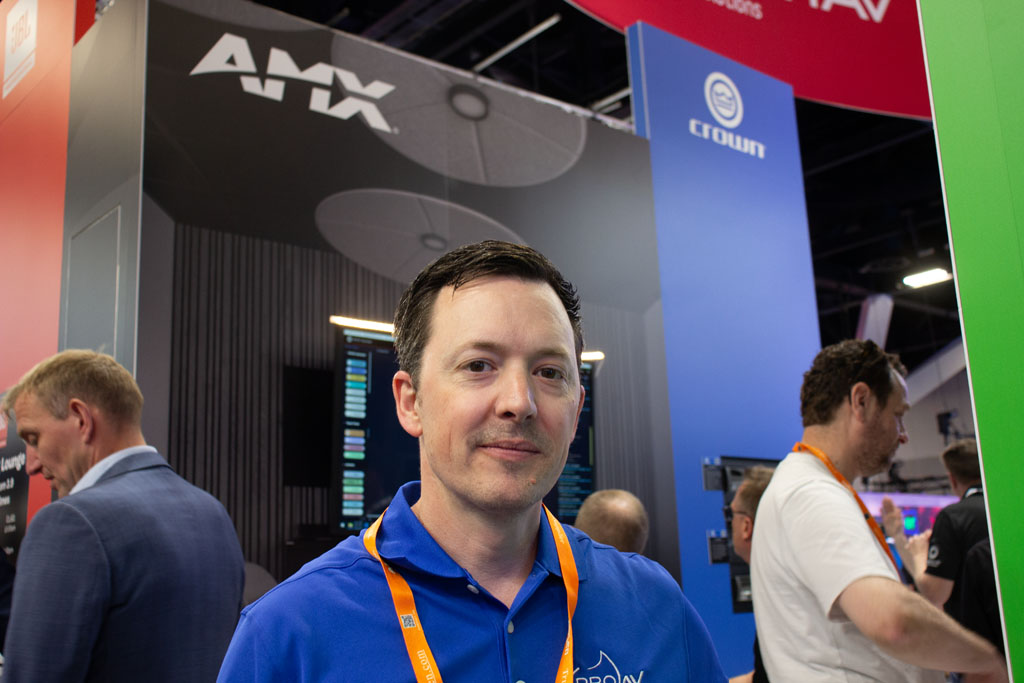
AMX MUSE
AMX MUSE Automation Controllers are powerful, secure, and reliable devices that provide a dedicated computing resource running HARMAN Professional’s AMX MUSE automation platform. They can simultaneously process a virtually unlimited number of scripts written in JavaScript, Python, or Groovy and natively support Low-Code development with Node-RED.
AMX MUSE Automation Controllers feature a modern embedded processor that’s 10 times faster than the processor in AMX NX Controllers, bountiful memory, and rugged, industrial-grade eMMC storage. Built on HARMAN’s secure Linux platform, MUSE controllers are designed to surpass the requirements of the most secure installations. Additionally, these controllers natively support HARMAN’s HControl (open-API), HiQnet (legacy HARMAN audio devices) and ICSP (legacy AMX control devices) protocols, making them the ideal automation processor for any space, environment, or application, whether old or new.
Steve Miles, Pro AV Solutions, Head of Defence and Secure Agency Deployment:
“I come from a technical engineering, programming, and commissioning background. I brought somebody on board to Pro AV to help us develop a platform so that we could standardise our software across multiple platforms and hardware. The idea was it would become industry-standard software development, not AV-specific software development. We could use industry-standard tools.
I presented our vision for this and how we could achieve it to our board. After about a year and a half of development, when we had the beta release done and a few clients were using our software, all written in Python and all open standards, I went to a pre-release with HARMAN and they were talking about a new platform that’s industry standard. It’s no longer a walled garden. It’s not AV programming.
Anyone who can write Python can work in the AMX MUSE environment. As soon as we started using it, it was a perfect marriage of our software to control AV and their hardware to do the talking.
We were coming from a software angle, but we didn’t actually have the hardware, especially not defence-approved hardware, that we could actually use. We got some beta-release MUSE hardware from HARMAN. With our programmer, we put it together, and in about 15 minutes, had an AV system running on brand-new hardware no one had ever used before. Now, we’re serving web pages for a user interface and remote support and everything else we need within about two hours of getting our hands on physical hardware. It’s been one of the most exciting projects I’ve worked on in AV.
In terms of AMX MUSE hardware, if we only need to do some fairly simple stuff like IP control for displays and a vision switcher, we’ll put in a MU-1000 and a touch panel. It’s simple, PoE, plug it in, rock solid. If we need serial ports for things like codec control or building management systems, we’ll end up putting in a bigger unit like the MU-1300 or MU-2300. The networks team love AMX MUSE because it all runs on good industry-standard network protocols.”
—
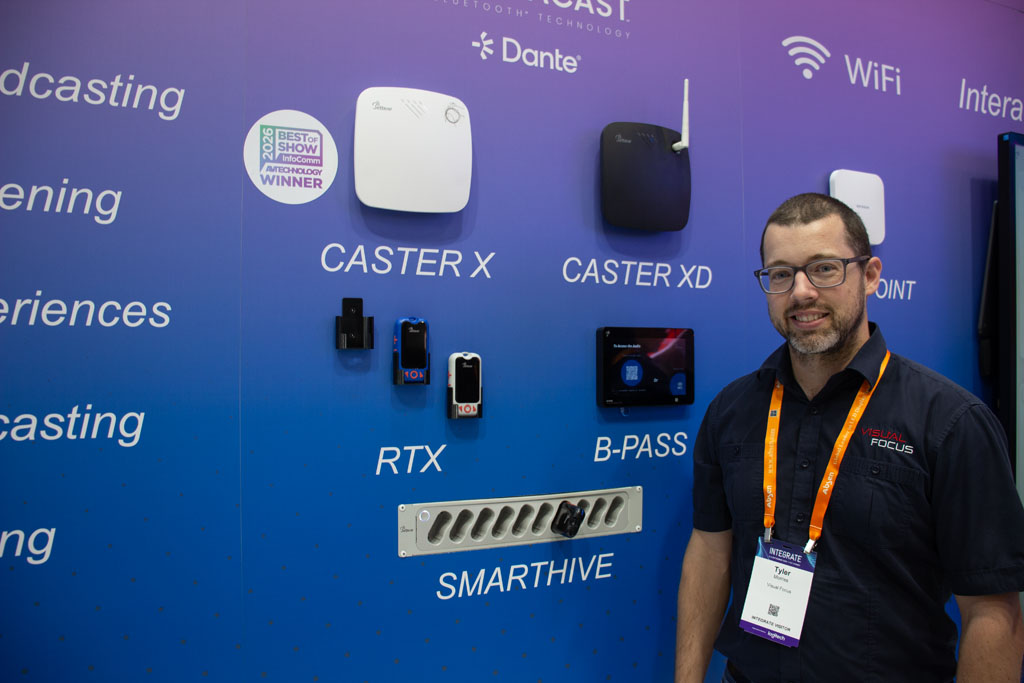
BETTEAR CASTER
CASTER is a professional Auracast transmitter delivering high-quality, low-latency audio across large-scale environments. Built for real-world deployments, it enables crystal-clear audio broadcasting to unlimited listeners, from theatres and classrooms to museums and transportation hubs.
Flexible by design, CASTER supports both open and secure broadcasts, making it suitable for everyday use as well as sensitive and confidential environments. With PoE in and PoE out, it enables clean installations and seamless cascading of power, audio, and control over Ethernet, combined with centralised management via Bettear’s Hive Central software.
Tyler Morris, AV Design Consultant, Visual Focus, Toowoomba, QLD:
“Bettear’s Auracast products are doing assisted listening properly. Bettear’s system is very simple; there are just two types of transmitters: one is analogue and the other one is a Dante version. It is not a system that customers will avoid using because of the constraints of infrared or an old-fashioned copper hearing loop.
People are going to be able to walk into a venue, scan a code, join the system, and use it. Or there’s the option to get a headset from the venue and then return it. If you’ve got people who’ve got newer hearing aids or newer mobile phones that have Auracast compatibility, they just walk in and connect directly.
All of this is transformative for the people who really need to use it most. Knowing now that we can do it within the budget of a project, we definitely recommend to the client that it’s worth doing now rather than later.”
—
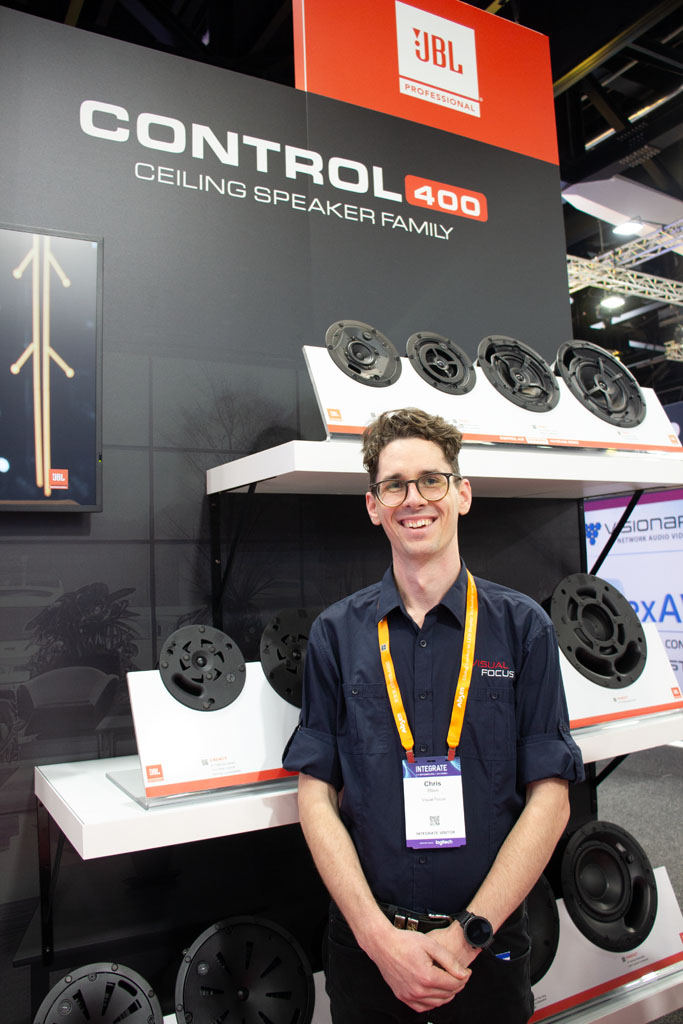
JBL CONTROL 400 CEILING SPEAKERS
As the successor to the JBL Control 20 Series, the new Control 400 Series extends that legacy with superior sonic performance, improved conical coverage, enhanced installation features, and a more modern aesthetic.
Adapted from its tour sound technologies, JBL Professional introduces its latest iteration of Radiation Boundary Integrator (RBI) technology: the Coplanar RBI, or CRBI. This technology provides an especially smooth sound character that remains consistent, clear, and pleasant across a wide coverage area. This enhanced coverage results in more consistent levels and can lead to fewer speakers and amplifier channels being required and, ultimately, significant project savings.
All models in the series include an all-new, full-face magnetic grille that blends seamlessly with modern décor. The supplied white grille can be easily painted to match any application’s décor. Optional black and square grilles are also available.
Chris Elson, AV Systems Design Engineer, Visual Focus, Toowoomba, QLD:
“They got rid of the bezels in the new 400 Series! One of the biggest complaints that we get is that it doesn’t matter if the speaker sounds the best; if it looks like a fire or PA speaker, they’re not interested. A lot of people didn’t like the old aesthetics. They’ve improved that, improved the grille design, and also made the speaker sound better at the same time.
Clients are spending money on decorative ceilings, and then you come in with a bezelled speaker that looks like a larger version of the crappy fire speaker next to it. How do you differentiate yourself from the $60 QuickFit model? Being able to now buy a square grille is great too, because a lot of customers are doing decorative ceilings that use 600 × 600 tiles, so they don’t want round holes in square tiles. It sounds minor, but we’re arguing with architects, interior designers and the customer!”
—
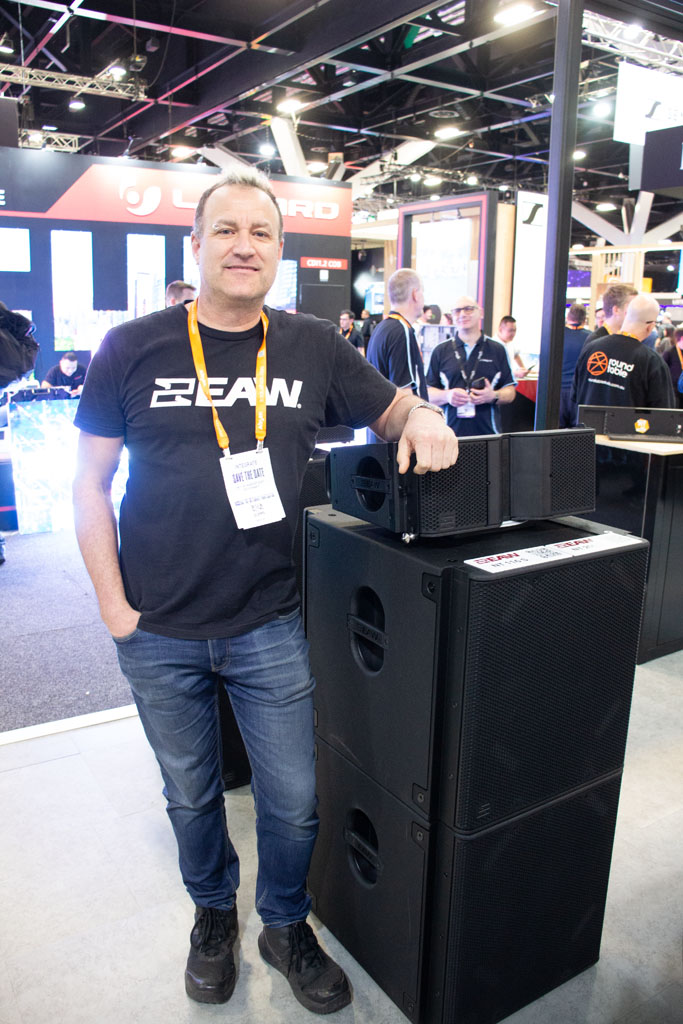
EAW NT208L AND NT116S
The NT208L is a dual 8-inch active line array that delivers a massive 141dB Max SPL with low frequency extension to 50Hz, delivering an output typically reserved for much heavier dual 10-inch or 12-inch systems. An active design that integrates a 2000W Class-D amplifier and field-adjustable horn (80°, 95°, or 110°) offers a versatile, tour-grade solution that optimises truck pack and coverage capabilities for large-format productions and for high-capacity installations.
With 50% more displacement than a 15” driver and 4000W of onboard power, NT116S delivers 135dB SPL and 25Hz extension that outperforms many larger-format subwoofers. Integrated rigging options allow NT116S to be integrated into a flown array of NT208L or deployed as a standalone LF solution.
Jimmy Den Ouden, Owner, Tech Room:
“The NT208L is part of EAW’s Newport range. It’s a dual 8”, and is joined here by the NT116S single 16” sub. That’s a weird driver size, but it really works and is quite musical. The dual 8s go down lower than you’d expect at 50Hz, and it all sticks together nicely. It’s all self-powered and pretty simple to deploy. There are knobs on the back where you set level, a high-pass filter, how many cabinets you’re using, and can dial in “Throw Distance” to make up for loss in the high frequencies over distance.
The NT208L has a cute little waveguide that you can pop out and flip around to change between 80° and 110° horizontal dispersion. You can even go asymmetrical by adjusting one part to 110° and the other to 80°, resulting in 95°. It’s really easy to do, too.”
—
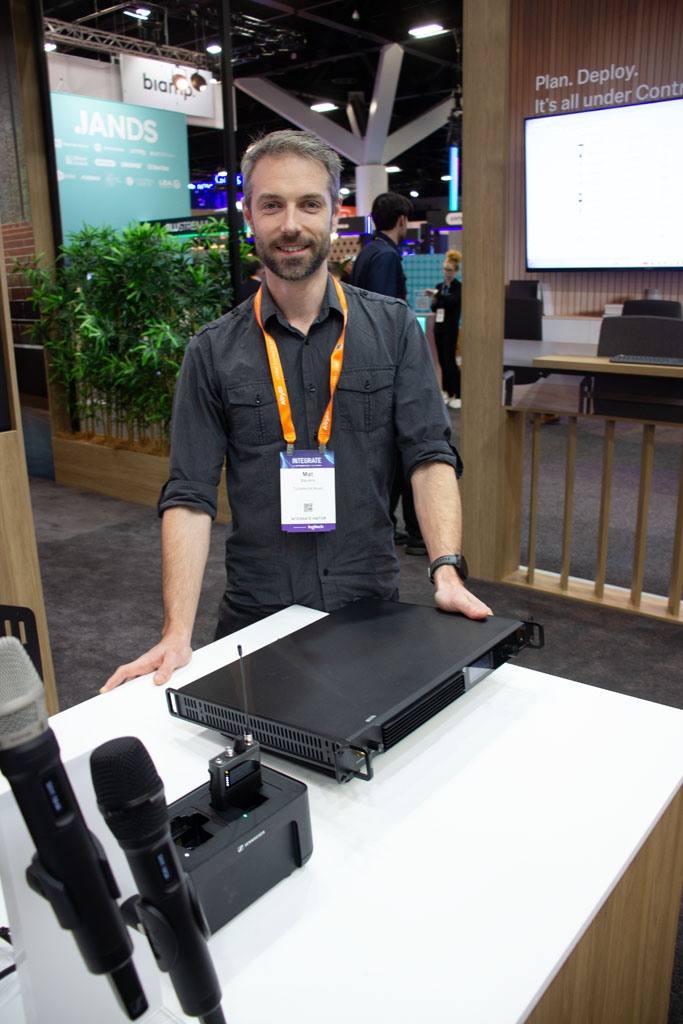
SENNHEISER EW-DX AND SPECTERA
EW-DX wireless microphone systems deliver a digital UHF system that can be scaled with ease. The system quickly assesses your environment and uses equidistant channel spacing to deploy frequencies while tools like Sennheiser’s Control Cockpit, Wireless Systems Manager and Smart Assist App allow you to monitor your system remotely. In-device charging, 12-hour battery operation, and switching bandwidth up to 88 MHz are only a few more of the many features that make EW-DX the right tool for the job.
Sennheiser’s Spectera features up to 64 channels (32 in/32 out) in a single unit, and is the world’s first wideband, bidirectional digital wireless ecosystem, providing audio professionals with unparalleled capability and flexibility. Spectera’s 11 Audio Link modes give you unprecedented control of latency, audio quality and more for each link, while its bidirectional bodypacks manage both in-ear monitor and mic/line signals simultaneously.
Mat Stevens, General Manager, Turramurra Music Centre:
“Sennheiser’s EW-DX has been a killer for us. The technology that they brought to the range and the price point has made it very accessible for schools, churches, and bands. It’s an affordable system while offering high-end digital wireless performance. We sell EW-DX at retail to whoever walks in the door that needs a basic system, through to large channel count systems for theatre, education and lots of other applications.
Meanwhile, Spectera has just transformed RF technology and it’s mind-blowing. That many channels in a single rack unit using WMAS technology will increasingly take over the top end of the market and broadcast space. For theatre, the fact that you can take 64 channels’ worth of receiver capacity in your hand luggage blows my mind.
We’ve sold Spectera into theatre and into education and had great feedback from the clients who are using it. They’ve been so impressed with the sound quality, which is not actually what we sold it on. We’ve been selling the technology, the convenience and the channel count, but the feedback is that the sound quality is something that’s been noticed straight away.
Spectera is continuing to develop and evolve, with new firmware coming out all the time, constantly improving the product. I know we’ll continue to see it deployed in more and more places.”
—
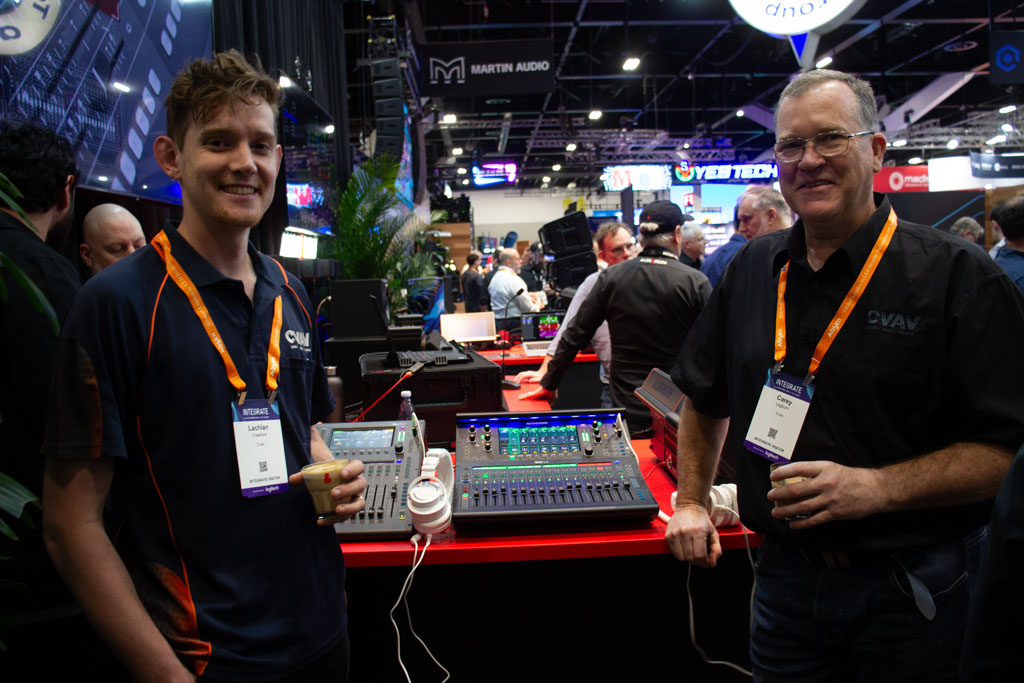
ALLEN & HEATH SQ+
Powered by Allen & Heath’s revolutionary XCVI 96kHz FPGA engine, SQ is built for professionals in demanding live sound, recording and streaming applications. Delivering class-leading high-resolution audio with an ultra-low <0.7ms latency, SQ gives you unrivalled power and audio fidelity.
Allen & Heath’s SQ+ mixers offer everything that made SQ the standard in compact mixing: the 96kHz XCVI core, ultra-low latency, class-leading audio quality, RackExtra FX, and DEEP Processing and now include flagship-tier RackUltra FX, more power per channel, and a transformed interface.
All SQ+ mixers include:
- 96kHz FPGA processing
- 48 input channels
- DEEP Processing ready
- 8 RackExtra FX Engines + dedicated sends and returns
- 4 RackUltra FX Engines + dedicated sends and returns
- 12 stereo mixes + LR
- 3 stereo matrices
- Intelligent 128×128 SLink port
- Range of remote expanders
- 64×64 I/O Port for audio networking
- 32×32 USB audio interface
- 9” touchscreen with dark GUI
Carey Leghorn and Lachlan Crawford, CVAV:
Carey: “We’re an AV integrator based in north-western Sydney. We work primarily in the Sydney metro area, but we’ll go anywhere. We’ve done jobs in Fiji, Singapore, and all over Australia. We’re specialist high-level riggers, so we do a lot of integration for other AV companies that lack those skills, or don’t want the liability of doing that work.
We’ve sold plenty of the SQ consoles, and the SQ+ is an upgrade with a slightly bigger screen and nicer faders. The button layout’s a bit different, and you get some of the effects that you used to have to pay for as part of the package.”
Lachlan: “I’m really liking the Deep processing and particularly the effects. It’s got the same reverb as the dLive, which is chalk and cheese compared to the SQ reverb that was built into the old one; it’s a much more realistic reverb. A bigger screen is always better, and I like the fader upgrade with a proper seal.”
—
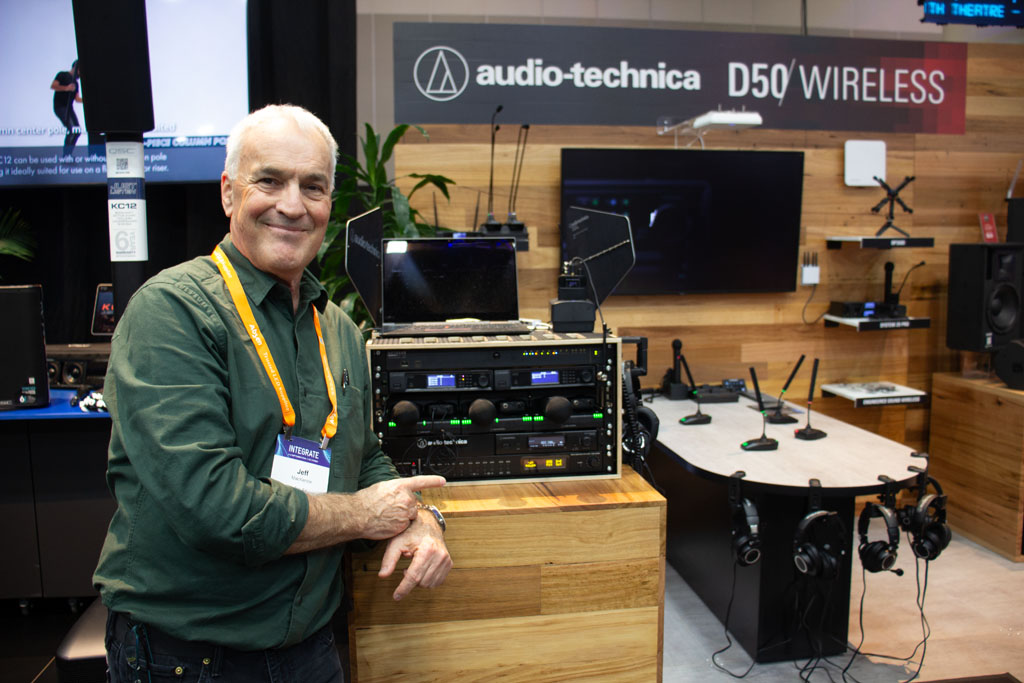
AUDIO-TECHNICA D50 WIRELESS
Drawing on decades of Audio-Technica digital wireless expertise, the D50 digital UHF wireless system was purpose-built to meet the true needs of integrators and users. D50 combines the best aspects of Audio-Technica’s existing models with useful technological advances to create a multichannel wireless system that leads its class in sound quality, RF stability, operational versatility, and value. Boasting an expansive bandwidth (up to 244 MHz, depending on region) in the all-important TV broadcast range, D50 wireless allows for secure, flexible channel planning wherever the system is deployed, even in the most complex RF environments.
Jeff McKenzie, Director, McKenzie Partners:
“Audio-Technica’s D50 Wireless has a lot of potential, as it’s at the right price point. There are a few cool things about it that I really like. It’s a half-rack-unit form factor with four channels of digital wireless, and it can be PoE- or mains-powered. You can daisy-chain four of them through the RF ports, so now you’ve got 16 channels in 2RU, networked, and you can get 16 channels, all on the network, without an external antenna combiner.
The battery charging solution is really nice. I like the form factor of their charging stations, and again, they’re networked, so you can change settings and push to the transmitter as long as it’s in the dock. For that price point, I don’t think there’s much out there, if anything, with those capabilities. I’ve certainly got a couple of projects in mind that this will be good for.”
—
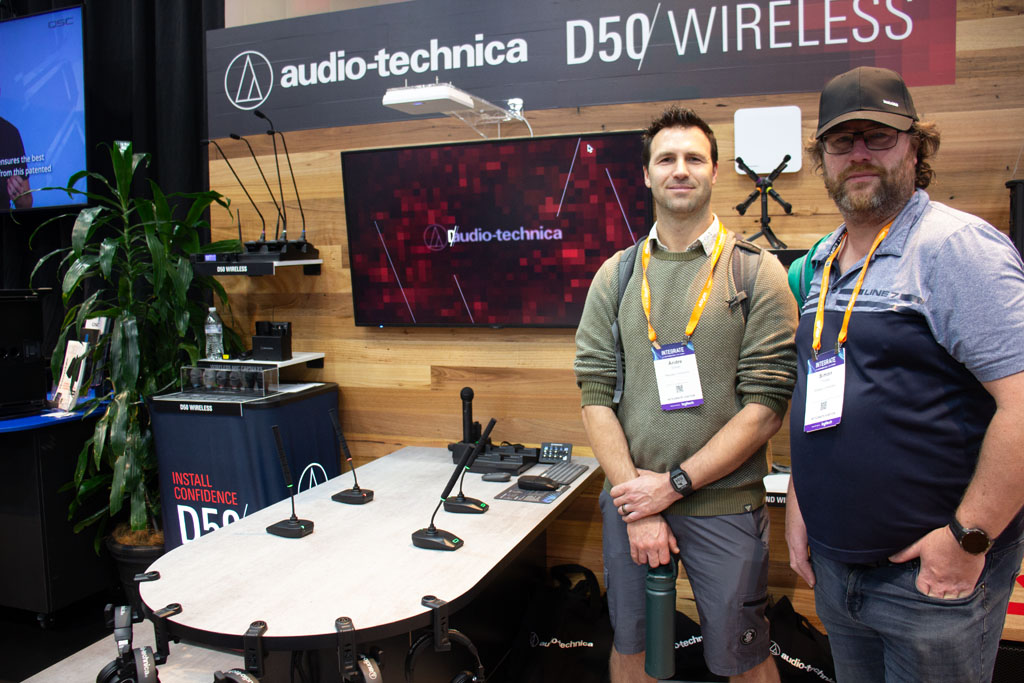
AUDIO-TECHNICA ENGINEERED SOUND WIRELESS
Audio-Technica’s Engineered Sound Wireless System is a DECT wireless system that offers simple, smart, and scalable high-quality audio. This system overcomes many challenges of conventional wireless microphones, such as frequency coordination and the limited number of simultaneous microphones.
Operation is incredibly easy, with microphones ready for use when removed from the charging station. Installation is also made easy using PoE to power the receiver(s) and Dante audio output capabilities. Engineered Sound Wireless is scalable up to 192 channels, with wiring as simple as connecting a single Cat 5e cable per receiver to a PoE network switch.
Internal batteries offer all-day operation on full charge. Boundary: up to 22 hours, Desk Stand: up to 17 hours, Body Pack: up to 25 hours, Handheld: up to 35 hours.
Andre Schorr, Technical Lead, Interactive Projects, Massey University, Auckland Simon Thorpe, System Engineer, Campus Systems, Massey University, Auckland:
Andre: “The upside of Audio-Technica’s ESW system versus what we’re currently using is the charging unit, and the way the microphones slot into it. Our current units use a ‘placement mat’ which charges, and sometimes users misplace a microphone slightly and then the battery runs flat. This charging system seems quite reliable because gravity slots it into place.”
Simon: “The microphones are set up to turn on automatically when you take them out of the charger, and the indicator light turns green to tell you that they’re on, both of which are useful features. The other thing I like about ESW is that it can run up to 192 channels, as we’re currently limited to 20.
Andre: I like the fact that the transmitters can be programmed to roam between receivers. If a lecturer goes into another room, the first receiver picks up that the transmitter is out of range, and the second receiver in the other room will start working. This is much better than a lecturer having to put one transmitter down, pick up another one, then another one, and so on.”
—
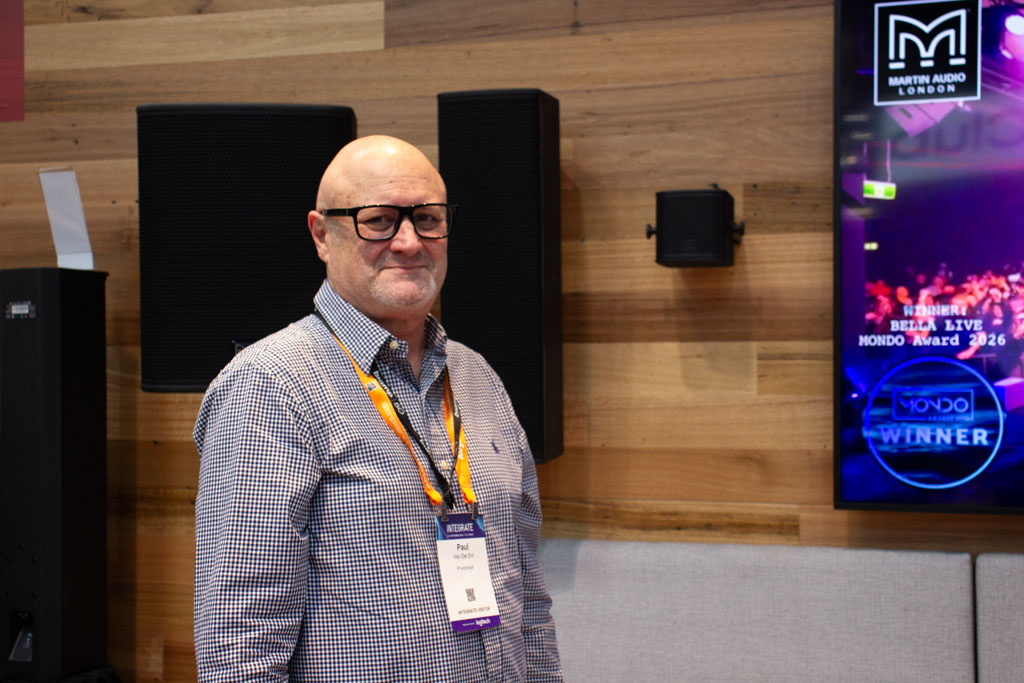
MARTIN AUDIO FP4
The FP4 is a point-source loudspeaker designed for short-throw distributed systems which require premium sound quality from a miniature enclosure. It delivers exceptional output and performance for its size and is ideal for installations requiring spot and fill coverage where space is limited. It measures just (W) 130 mm × (H) 130 mm × (D) 126 mm, and weighs only 1.9 kg.
The FP4 is a two-way passive design featuring a 4-inch LF driver and a 0.7-inch exit HF driver with a 1-inch-diameter high-temperature polymer dome. It has an impressive maximum SPL of 108 dB peak, and its Coaxial Point Source configuration produces a well-defined, conical 110° dispersion pattern which is perfect for close-proximity applications.
Paul van der Ent, AV Designer/Engineer, Project Director, and Consultant, PRVconsult:
“The Martin Audio FP4 is great because it just sits there and works. Two little speakers that size are very easy to mount on a wall, making them great for corporate situations as well as theme parks and museums. Combined with a Martin Audio SX subwoofer, they’re amazing. It is such a high-powered system for the size, and I think you could quite easily put a small band through it without any issues.
I’ve used the FP4s on a recent job, supplied by distributor TAG, who are always wonderful. Their support is amazing; if you’ve got any issues, they’ll be there 24/7.”
—
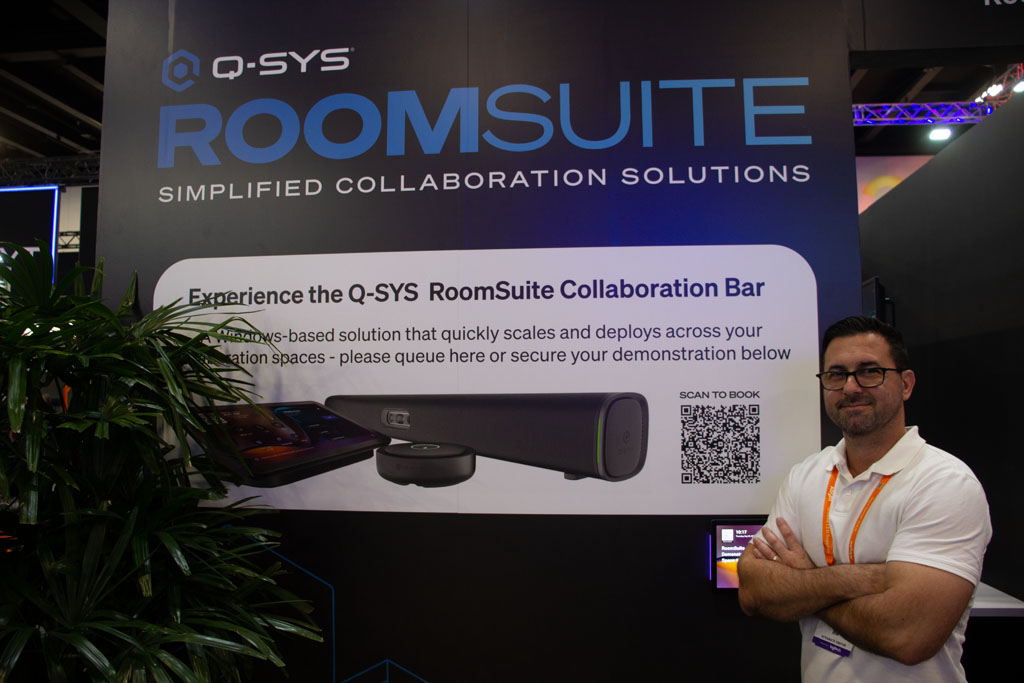
Q-SYS ROOMSUITE COLLABORATION BAR
The Q-SYS RoomSuite Collaboration Bar and expansion devices provide a scalable AV solution for standard small-to-large meeting spaces. This Windows-based solution features built-in audio and video and supports Microsoft Teams Rooms and bring-your-own-meeting conferencing.
It features four high-resolution cameras, a 16-element microphone array and integrated loudspeakers. The included 10.9-inch touchscreen controller simplifies meeting management and AV bridging, while up to four optional table microphones provide flexible audio coverage with mute sync.
Max Di Torro, Owner and General Manager, Audio Visual Projects, Darwin, NT:
“The soundbar form factor is replacing what used to be a lot of different bits and pieces. Previously, we’d use a lot of USB switches, HDMI distribution amps, and there’d be cables everywhere, whereas now there’s an all-in-one solution. It’s a single cable connection with Teams and BYOD connectivity.
We predominantly use Q-SYS in our larger boardroom and conference room setups. Products like the RoomSuite Collaboration Bar make it easier for everyone, including the integrator and the end user. It will cover medium-sized and even larger rooms. It keeps everything nice and neat; no trip hazards, and with simple one-cable connectivity, it’s just plug and go.”
—
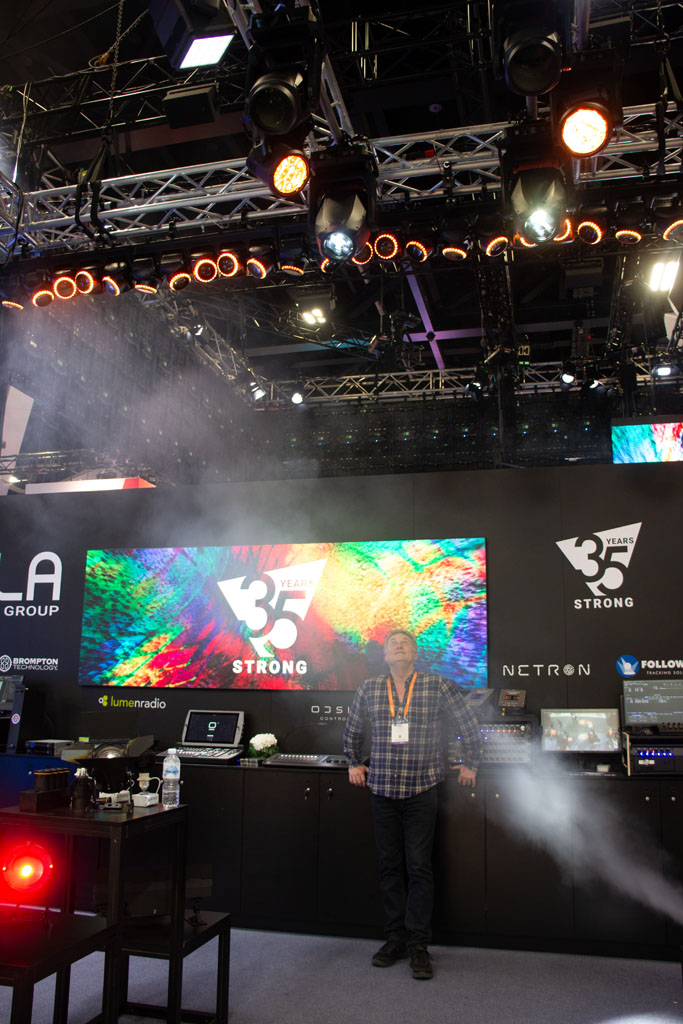
ACME TORNADO
The ACME TORNADO boasts a powerful 5 × 120W RGBL LED as its main light source, complemented by a ring of 120 × 0.5W RGB LEDs encircling the fixture. The fixture is equipped with five individual light heads featuring precise pan and tilt movements. Each head can be controlled independently, offering limitless possibilities for artistic exploration and creation. The linear zoom runs from 3° to 30°, with a field angle of 4° to 35°. With an all-weather IP66 rating, the TORNADO is designed to withstand the elements.
Andrew Gayler, Owner, AJS (a.k.a. Andy J Sound):
“My staff came to me and they said, “What a great way to put up five lights by putting up one.” That was the pitch! I reached out to ULA Group, looked at the price point, and thought it was great. We use a fair bit of ACME in nightclubs. We try to kill it, but it doesn’t die. And if you do kill it somehow, you can actually fix it and get parts. That’s great for a rental company. Tornado is definitely turning into ‘a thing’; we started seeing it on a few riders, and the next minute we’re seeing it on everyone’s riders. It’s one of those things that you just need to own in your hire inventory.
We’ve got 20 units, so I guess you could call that 100 lights? 100 things that move? It’s a great example of how, even though you think they’ve invented everything, here we are: here’s something new that no one had thought of yet that actually does a really good job. It’s a great product, and I think it’s something that all rental companies should consider owning as part of their fleet.”
—
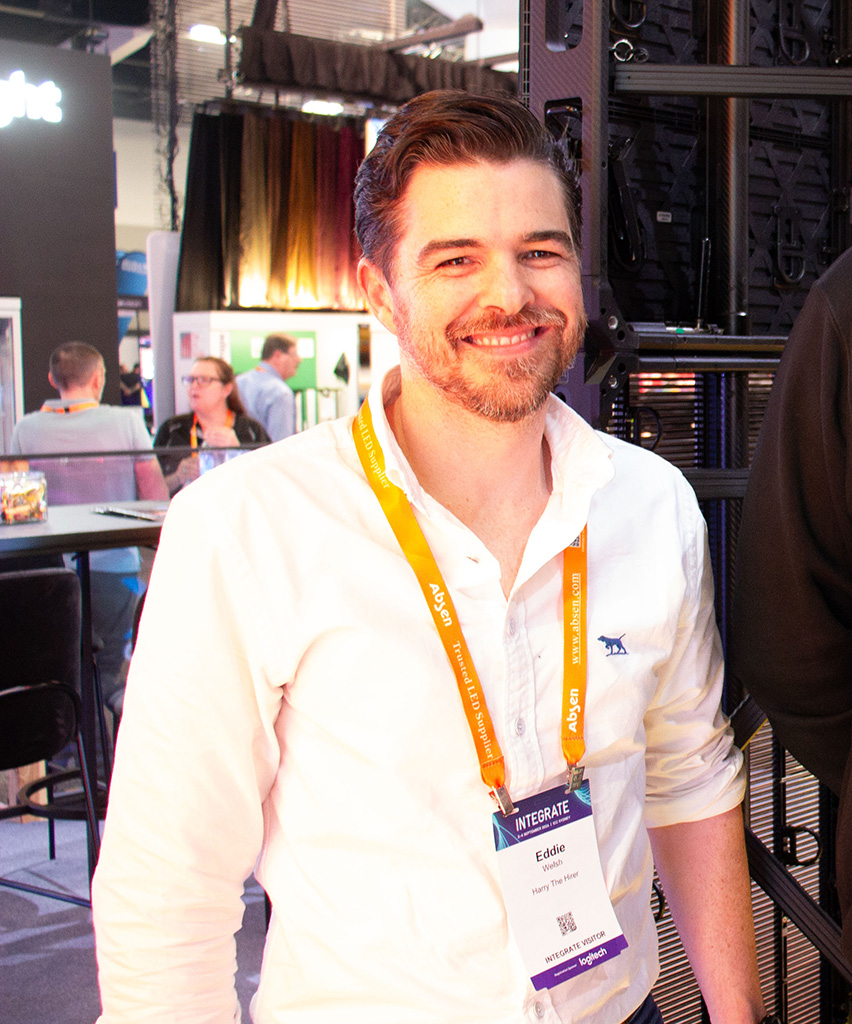
VUEPIX BLACK WIDOW AND GX2
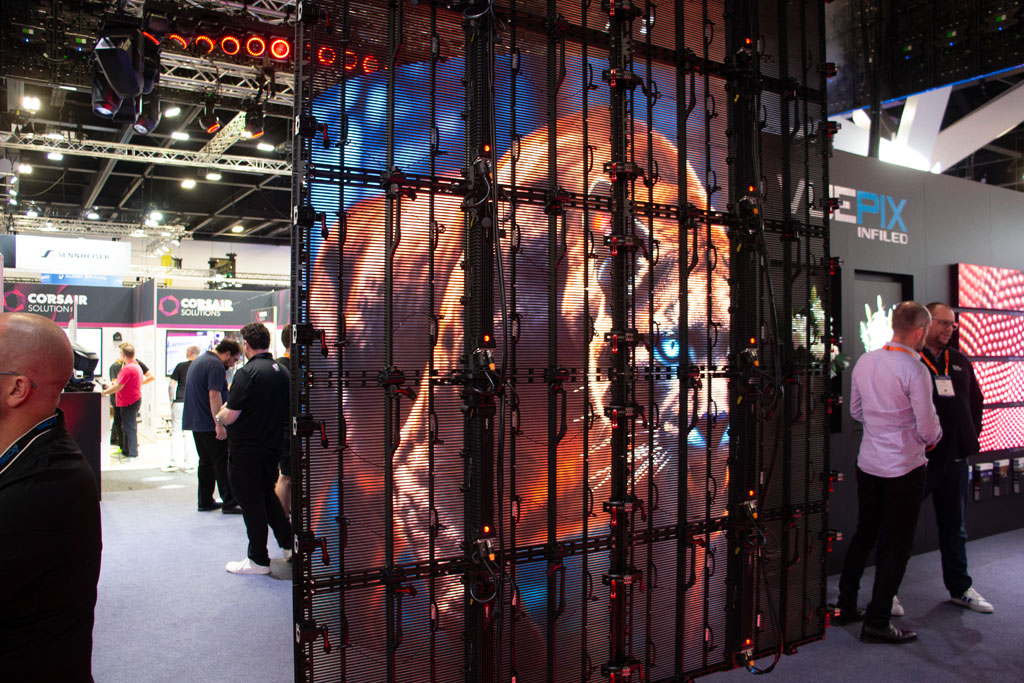
Black Widow LED video panels are engineered with lightweight yet durable carbon fibre, weighing merely 29 kg per square metre. The panels seamlessly transition between indoor and outdoor settings. Featuring advanced black LED chips, they deliver striking contrast and vivid imagery even in challenging lighting conditions.
The wind-resistant frame is portable, easily detachable, and durable against wind speeds up to 20 m/s. It can also be used as a climbing frame for on-site maintenance tasks. With IP65 front and rear protection, these screens offer stable and reliable operation in any environment. The cabinets can be hung or stacked, reaching heights up to 26 metres when hung.
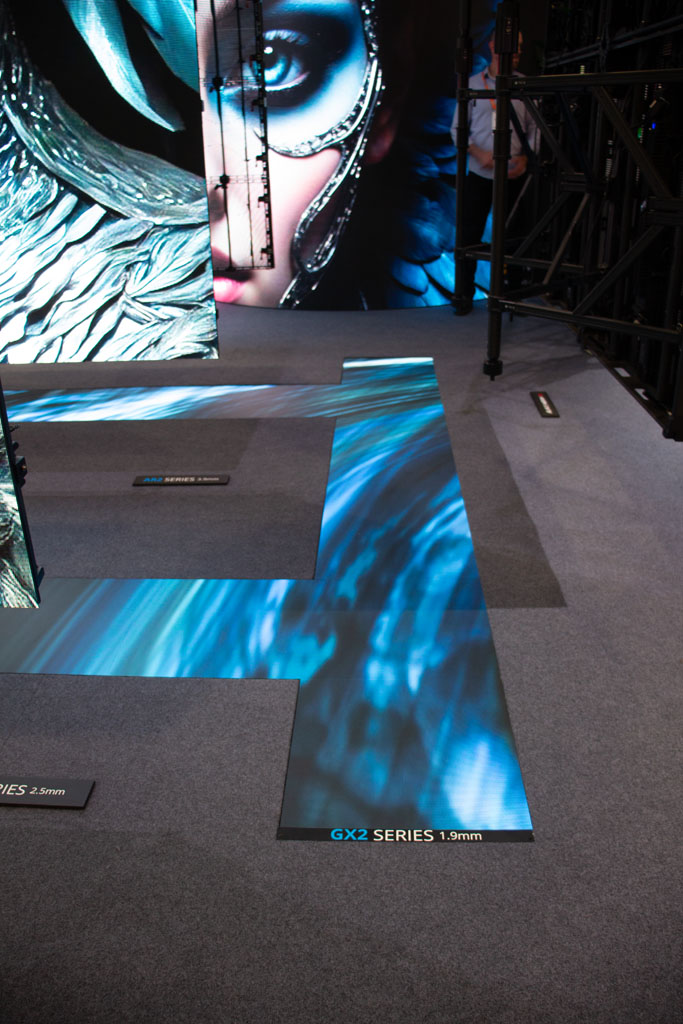
VuePix INFiLED GX2 series is a high-powered multipurpose LED solution for both indoor and outdoor applications. It has been engineered to offer a lightweight design yet solid performance in any environment. The robust frame is made of die-cast magnesium and aluminium alloy and features enhanced corner protection to prevent the LED diodes from physical damage during transport and handling.
The GX2 series offers flexible mounting and installation possibilities, allowing designers to achieve seamless flat, arc, wave and creative configurations. The LED cabinets come in two different sizes, a half-panel (500 x 500 mm) and a full panel (1,000 x 500 mm). The all-in-one PDU unit is easily exchangeable, with the option of both front and rear maintenance.
Eddie Welsh, General Manager, Harry the hirer:
“We first saw Black Widow at LDI a few years ago in its first release. Harry the hirer worked with VuePix to make some changes to better suit our work and the Australian market. A lot of the changes we made were around accessibility and functionality in terms of how we actually put it up. There are a few changes in the way that LED modules work, but the biggest change for us was around foot placement when you climb it. We made the holes bigger for putting a big Australian steel-capped boot in.
Black Widow already had a very well-designed cart and dolly system. We just added a few tweaks, including glow-in-the-dark pins and levelling devices to be able to put multiple carts together, level them out, and lift the screen out faster.
Those sorts of functional improvements are the kind you can only get from someone that uses the product every day. VuePix are really accommodating, and it helped improve a product that they can then sell to someone else.
Black Widow is a good investment for us because it straddles the line between the touring and corporate markets. We’re a very diverse company that works across a lot of different markets. We’ve used Black Widow on everything from AWS Amazon Summit through to Hilltop Hoods.
In terms of VuePix GX2, we’ve seen a lot of LED floors, but this is clever for a number of reasons. The bearers are clever, as is the way it levels out. There’s a really nice finish between the panels; a lot of LED floors have significant gaps between the panels and the joints. The matte finish is good; glossy floors look a bit kitsch, but this floor looks sharp.”
Subscribe
Published monthly since 1991, our famous AV industry magazine is free for download or pay for print. Subscribers also receive CX News, our free weekly email with the latest industry news and jobs.
Recent posts