PROJECTION
2 Jul 2026
Projection Mapping Beyond the Spectacle: The Electric Canvas at Sovereign Hill
Subscribe to CX E-News
Projection mapping is often judged by what the audience sees: scale, brightness, animation, colour and spectacle. But the most successful projection projects are usually defined by what the audience does not see; the planning, infrastructure, environmental design, technical redundancy and site-sensitive installation that allow the illusion to work night after night.
For The Electric Canvas, Sovereign Hill’s Winter Wonderlights has become one of the clearest examples of this kind of long-term projection thinking.
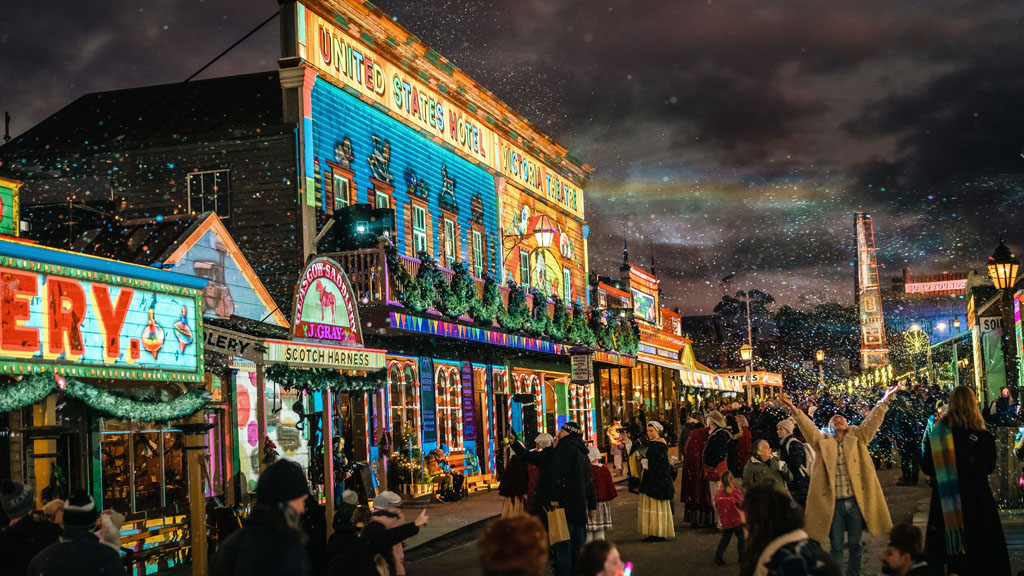
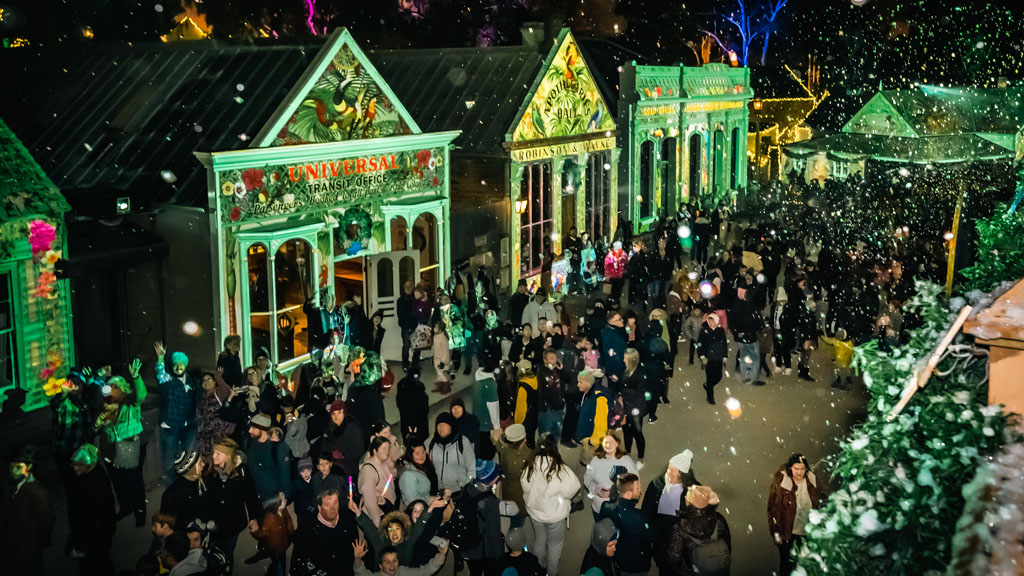
Since 2014, TEC has designed and delivered the annual Winter Wonderlights projections across Sovereign Hill’s historic Main Street in Ballarat. What began as an ambitious projection mapping project across approximately 12 façades has grown into a large-scale, multi-building experience, covering 26 historically replicated shopfronts and trade workshops.
The project is not simply a matter of projecting animated content onto buildings. Sovereign Hill is an outdoor working museum, carefully designed to immerse visitors in an 1860s gold mining town. That creates a very particular challenge: how do you introduce sophisticated event technology into a heritage-style environment without compromising the integrity of the site?
The answer lies in treating projection as part of the place, not something imposed upon it. This principle has guided The Electric Canvas’ approach to Winter Wonderlights (and so many of their projects) from the beginning.
Working within a living museum
When Sovereign Hill first approached TEC to deliver Winter Wonderlights, the project came with a very short lead time. There was no opportunity to develop detailed scans or models of the buildings, so the team created accurate mapping templates using point-of-view photography. This required careful determination of projector positions from the outset, because content, viewing angles and image geometry were all tied to the physical layout of Main Street.
Those early decisions established an approach that has continued to evolve over the life of the event. Projector positions are refined year after year, balancing technical requirements with the visual sensitivity of the museum environment. Equipment needs to be concealed from public view as much as possible, while still achieving appropriate coverage, resolution and shadow management.
This is where The Electric Canvas’ experience in architectural projection becomes particularly important. The company’s work is not only about producing content for a surface; it is about understanding the surface, the site, the audience movement, the sightlines, the constraints and the operational realities.
At Sovereign Hill, those realities are considerable. The site remains open to visitors during the day, with museum operations, staff, vehicles, horses and public activity continuing around the installation. Crews must work discreetly during operating hours, and more intrusive activities, such as crane lifts, are limited to night works.
The result is a projection system that has to be technically robust, visually sympathetic and operationally practical.
Projection as a storytelling system
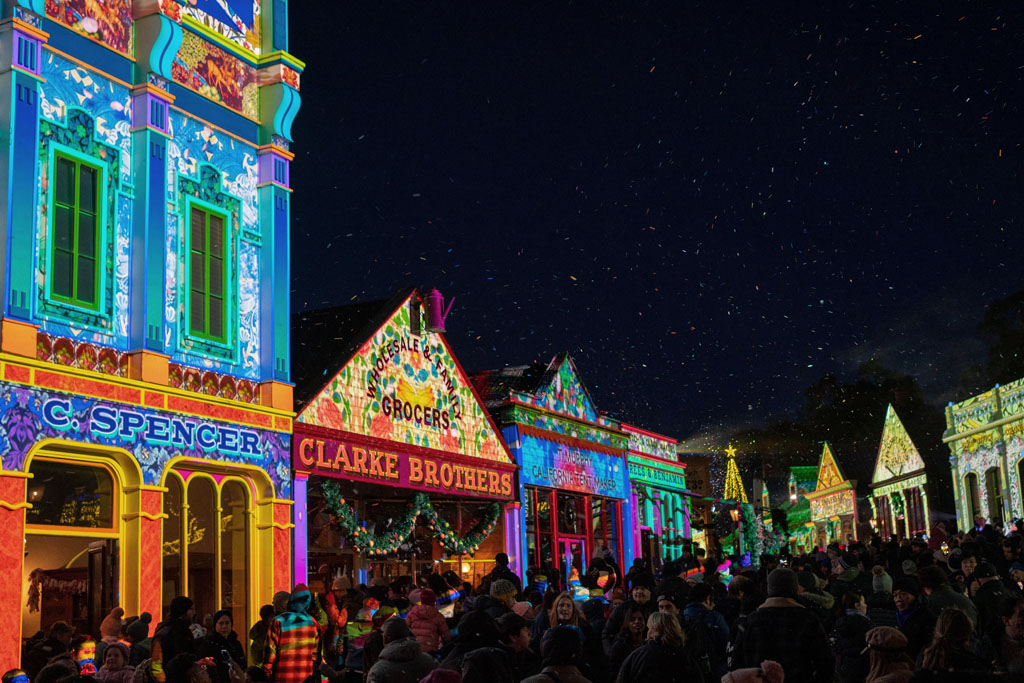
Winter Wonderlights has grown not only in scale, but in creative complexity. Each year, Sovereign Hill selects a series of themes from a growing repertoire of animated scenes, all mapped to the architectural features of the buildings and supported by a bespoke soundtrack.
Over the years, narrative elements have been woven into the projections, including characters such as a mischievous gingerbread man, Sovereign Hill’s Redcoat soldiers and an animated dragon that snakes its way through the streetscape.
These characters create moments of surprise and humour, but they also introduce a sophisticated spatial design challenge.
Main Street is not a flat screen. It is a long, narrow, three-dimensional environment through which visitors move. A character appearing on one building may be clearly visible from one location, partially visible from another, and completely missed from elsewhere. The Electric Canvas’ content designers therefore need to plan action, timing and audience focus with great care.
Multi-channel audio becomes an important part of that experience. Sound can be used to direct attention to specific areas of the projection footprint, helping audiences understand where to look and when. Projection, audio and site-wide show control work together to create the sense that Main Street itself has come alive.
This is one of the strengths of architectural projection when it is handled well. It does not replace the architecture; it transforms it. The buildings remain recognisably Sovereign Hill, but for the duration of the show they become part of a temporary theatrical world.
The technical system behind the magic
While the visitor experience is designed to feel seamless, Winter Wonderlights is one of The Electric Canvas’ most technically complex annual projects.
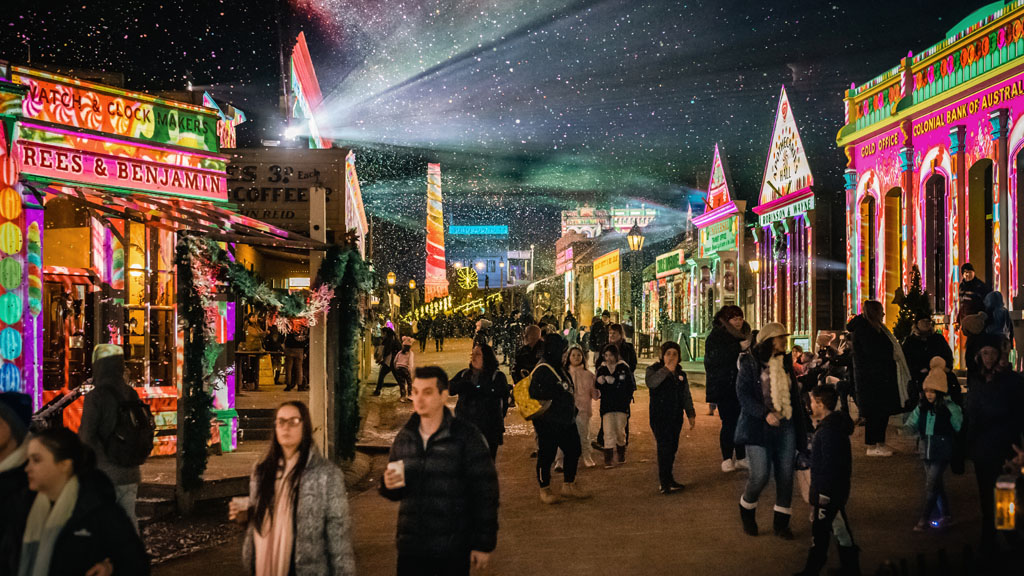
The system requires more than 30 projectors operating across the site, with as many channels of synchronised HD playback delivered from multiple media server clusters. A full set of live backup channels allows for immediate failover in the event of a technical issue. Multi-track audio can be distributed across the projection footprint over a Dante network, and signal and network reticulation rely heavily on a robust fibre backbone with redundant network topology.
This level of redundancy is essential. Winter Wonderlights is a ticketed public experience with a concentrated show window. If a projector fails, a signal drops or an image visibly misaligns, the audience notices immediately. In this context, reliability is not just a technical requirement; it is part of the creative promise.
The Electric Canvas also developed a power diversity strategy for the site. Because the event draws from various existing power supplies across the property, the system needs to be planned so that the loss of a single supply has the least possible visual impact. In some cases, it is better for an entire façade to go dark than for multiple façades to be partially affected. That kind of thinking reflects the difference between simply making a system work and designing a system that can fail gracefully.
Designing for Ballarat winter conditions
Outdoor projection always has an environmental dimension, but at Sovereign Hill, that dimension is significant. The equipment operates in a dusty, cold and sometimes windy environment, with freezing overnight conditions followed by the heat loads of projector operation.
To protect the projectors, The Electric Canvas designed and implemented custom environmental enclosures incorporating filtered ventilation, heating and housekeeping electronics. Chassis heaters were also fitted to reduce the impact of overnight shock cooling before the projectors heat up during operation.
These details sit well outside the glamour of projection mapping, but they are fundamental to the success of the event. A projection system is only as good as its ability to perform consistently under the conditions of the site. For long-running public events, the engineering behind the image is as important as the image itself.
Alignment under pressure
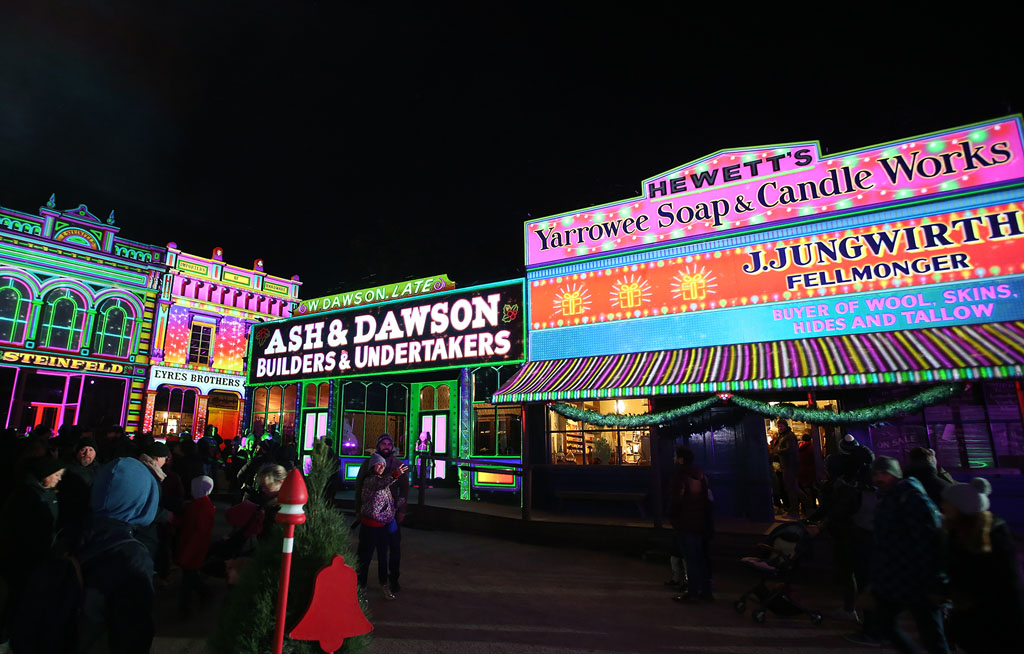
One of the most demanding parts of Winter Wonderlights is the line-up. Achieving pixel- accurate architectural alignment across 26 façades would normally require several nights. At Sovereign Hill, that process generally has to be compressed into one or two nights at most.
The Electric Canvas manages this through a workflow that allows multiple mapping alignments to happen simultaneously across the site. In practical terms, this can mean several technicians working across different sections of Main Street at the same time, laptops in hand, adjusting content to architecture in cold and often challenging late-night conditions.
This is where the craft of projection mapping becomes highly visible to those behind the scenes. The audience may experience the final result as effortless, but the precision required to align content across dozens of façades is substantial. Every window, cornice, balcony, sign, doorway and roofline becomes part of the canvas.
A long-term partnership with place
The success of Winter Wonderlights is also a reminder that projection projects do not need to be static. Since its first year, the event has continued to grow and evolve, with new themes, new animated scenes and new technical refinements added over time.
For Sovereign Hill, the result has been a winter event capable of attracting large audiences during a traditionally quieter period. For visitors, it has become a multi-generational experience, with many people returning year after year. For The Electric Canvas, it has become a showcase for the kind of projection work that sits at the intersection of creativity, engineering and operational discipline.
The project demonstrates why projection remains such a powerful tool in the event technology landscape. In an era of LED screens and permanent digital infrastructure, projection offers a different kind of transformation. It can adapt to architecture rather than cover it. It can bring heritage environments to life without permanently altering them. It can scale across irregular surfaces, respond to place, and disappear when the event is over.
That is where The Electric Canvas’ role is most valuable. The company is not simply supplying projection equipment or producing animated content. It is designing a complete site-specific projection system: one that respects the environment, supports the story, manages the technical risk and delivers a repeatable public experience.
At Sovereign Hill, the result is more than a winter light show. It is a demonstration of what architectural projection can achieve when it is designed with care, delivered with precision and refined over time.
Projection mapping may begin with light, but in projects like Winter Wonderlights, its real power lies in the ability to transform how people experience place.
Subscribe
Published monthly since 1991, our famous AV industry magazine is free for download or pay for print. Subscribers also receive CX News, our free weekly email with the latest industry news and jobs.
Recent posts