AUDIO
17 Apr 2026
Sennheiser EW-D SKM at Meeniyan Hall

Subscribe to CX E-News
Meeniyan Hall goes wireless for Annie and the Caldwells
Digital wireless systems are a dime a dozen on live stages, but the name Sennheiser still adds a layer of surety and confidence to the equation, not to mention sound quality.
Last month I was lucky enough to work on a run of live shows at Meeniyan Hall in regional Victoria, with a dozen or so bands, many of whom were also in Australia to perform at WOMAD or the Port Fairy Folk Festival. Lyrebird Arts Council, who organise these special gigs at Meeniyan Hall, have a long tradition of attracting international acts to this quaint country hall, where artists are treated to a friendly, welcoming atmosphere, a magnificent home‑cooked meal, and a backstage area that looks like a scene out of Hogwarts.
At one these shows – Annie and the Caldwells from Tupelo, Mississippi – we had the pleasure of using Sennheiser’s EW‑D wireless microphone system, with SKM handheld transmitters in the hands of all four female vocalists. I’d not used these mics before at a live show, so this was my first interaction with them on stage in front of a live audience.
For the backing vocal trio of Anjessica Caldwell, Deborah Caldwell Moore, and Toni Rivers we used screw‑on e835 cardioid dynamic capsules, while on the main vocalist, Annie Caldwell sang through Sennheiser’s MM 435 dynamic cardioid capsule, with its detailed, lightning‑fast aluminium copper voice‑coil.
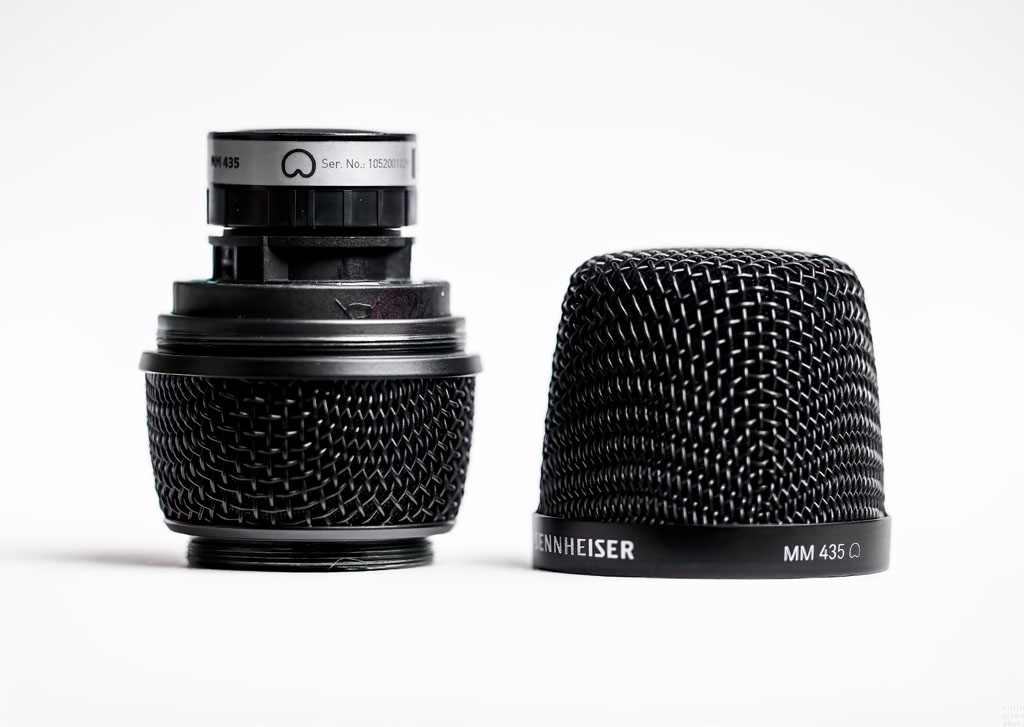
Cutting straight to the chase here, the MM 435 dynamic capsule is quite superb sounding: clear and balanced, full‑toned and crisp. The microphone transmitter and capsule combination are a total pleasure to sing into. I gave the mic a good run before soundcheck while I was setting up the stage and was stunned by what came back through the Nexo foldback.
Easy to hold, with minimal handling noise, and a flat‑topped grille (which I like) the SKM MM 435 combination is a reliable, superbly built wireless system. The only contentious component on the SKM bodies are the mute switches, which some engineers love and others don’t, although this can be disabled via the mic’s internal menu options if you don’t like the idea of artists finding a way to switch the mic off accidentally.
Before the show, we were forced to put tape on all four handhelds so that the women didn’t mix the mics up backstage, hence the tape clearly visible in the photos. Annie and the Caldwells typically start their shows instrumentally, with the guitar, bass, and drums of Willie Joe Caldwell, Sr. (guitar), Willie Caldwell Jr. (bass), and Abel Caldwell (drums) kicking things off, the ladies then singing while they’re still backstage – hence the need for the mics to be labelled.
This process quickly tested out the wireless system’s capacity, which worked flawlessly on the night. The Caldwell singers also like to wander out into the audience during their shows – which they certainly did on this occasion – and here too the mics were stable and clear: no feedback or reception issues whatsoever. Lachlan Wooden, who was travelling with the band, tested the mics on the floor pre‑show to make sure there were no nasty surprises later.
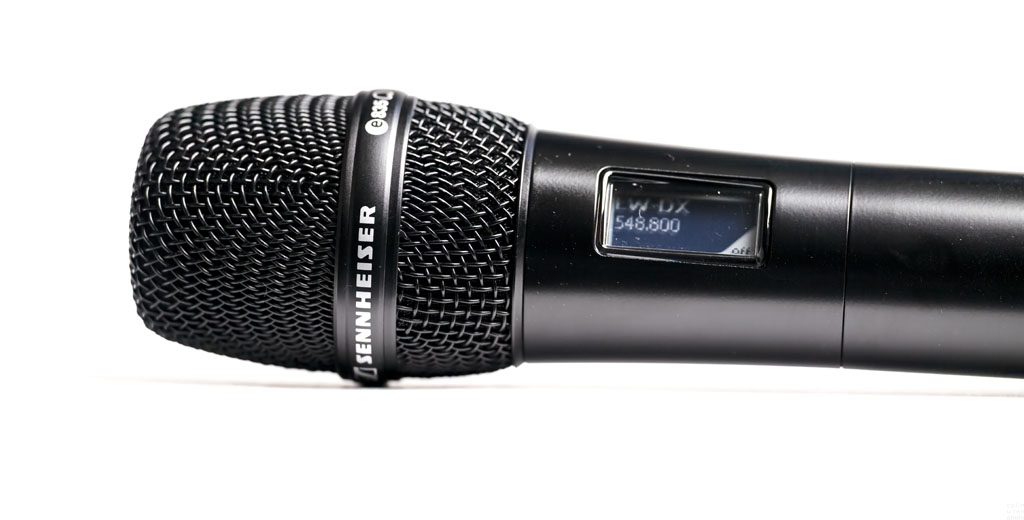
This was my main concern at the show actually – that the singers weren’t going to cause problems by wandering too far from the antennas and receivers on stage or wave their mics at the PA and cause feedback. True to form, they did wander – but the mics were stable throughout, with not a hint of feedback or reception issues.
One thing about these mics – particularly the MM 435 capsule – is that they are detailed and clear. The 435 is lighting fast, which has obvious benefits as well as potential downsides, depending on the singer.
With Annie Caldwell, who has a voice like a freight train, there were times when she probably needed more radical multi‑band compression at around 5k than we could provide on the night, but she sounded amazing nonetheless. But on a separate occasion, at a second gig where I used the mic on a male crooner performing solo with an electric guitar, the EW‑D SKM handheld with the MM 435 capsule sounded stunning, with no sense whatsoever that the upper mids needed controlling.
It was a perfect insight into the ‘sound’ of a mic. On these two separate occasions, the same mic sounded quite different. What might have felt like a potential shortcoming of the MM 435 capsule at one gig, proved a strength at the other. The ‘sound’ of the mic was totally dependent on the singer and the circumstance.

It proved yet again – if proof still needs tabling – that mics don’t make a sound, they capture sound. It’s often a misstatement of fact to say that a mic ‘sounds’ like this or that, when in fact it’s the singer and their interaction with a mic’s mechanics and electronics that has the single biggest influence over the outcome – it seems like an obvious thing to say here, but it’s an often forgotten fact, especially in general conversation.
I’ve had lots of mics on stands over the years, and not one has made a sound until something has interacted with it. Actually, come to think of it, my old Neumann U67 used to make some weird noises on its own occasionally, but a new valve fixed that problem… but I digress.
What I would contend with Sennheiser’s MM 435 capsule in particular (which seems to receive the same old negative criticisms by those who want the capsule to sound ‘punchier for rock gigs’ – why, I have no idea), is that it sounds like a condenser without the negative consequences of the mic hoovering up sound from all corners of the stage.
I love this combination. You get the fidelity without the sensitivity to feedback some condensers are prone to, or the lead vocal mic acting on occasion like an unwanted room mic for the drum kit.
There are thousands of mics in the world these days claiming to be the best for live performance. In the world of wireless, Sennheiser are at the technological forefront: of performance, build quality, reliability and sound.
I had no issues with the EW‑D system on the nights we used it, and felt strongly that the MM 435 capsule on top of its SKM handheld transmitter produced some of the best live vocal outcomes – wireless or otherwise – I’ve ever had the pleasure to hear or mix.

Subscribe
Published monthly since 1991, our famous AV industry magazine is free for download or pay for print. Subscribers also receive CX News, our free weekly email with the latest industry news and jobs.