News
15 Jun 2026
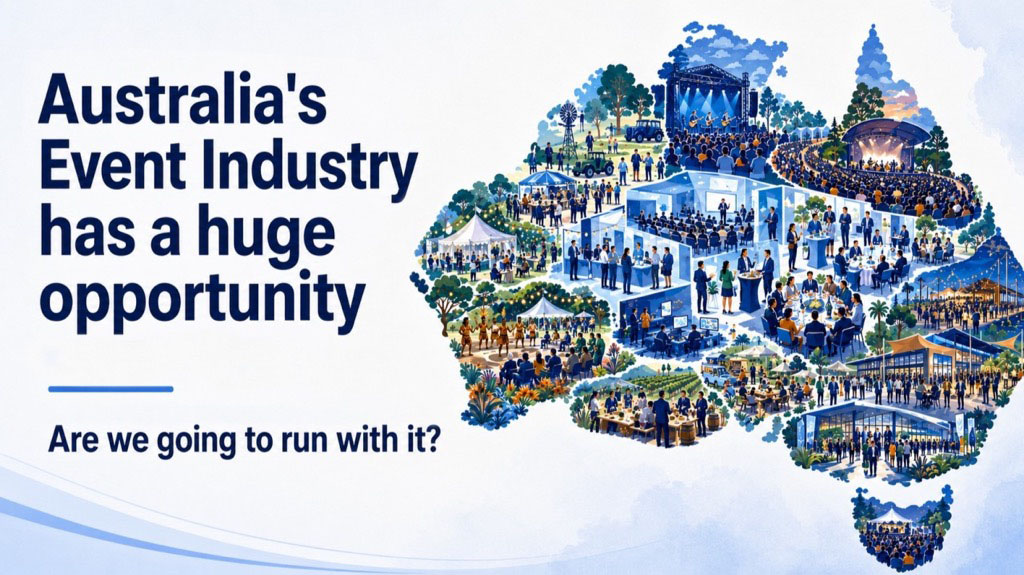
Australia’s Event Industry has a huge opportunity. Are we going to run with it?
Subscribe to CX E-News
I’ve spent a significant amount of time recently analysing government policies relating to events and the Event Industry in every state and territory in Australia.
What I’ve found is striking. Across the country, governments are now placing events at the centre of state strategies, economic development plans, and long-term policy frameworks. And they’re doing it at a level we haven’t seen before.
This isn’t just about governments spending more money on events. It’s about a fundamental shift in how they understand what events do and the role they can play in their economies and communities.
A growing number of governments are recognising that events drive industry development, workforce capability, trade and investment, knowledge exchange, regional economic activity, community connection and place identity. They are starting to see events as economic and social infrastructure – central to how their states and territories grow, compete and connect.
This creates a huge opportunity for Australia’s Event Industry. One that most people in our industry won’t be fully aware of. It’s worth understanding what’s happening.
The Scale of Ambition
The ambition around events in Australian government policy is genuinely significant.
Queensland has the stated aim of becoming Australia’s event capital. Events are a central pillar of its Destination 2045 strategy. The strategy calls for an integrated whole-of-government approach to major, regional and business events. Events as core state infrastructure.
New South Wales has positioned events as a key pillar of its Visitor Economy Strategy 2035 and has signaled its intent to further dominate business events nationally.
Western Australia is aiming to be the fastest-growing major events destination in the South East Asian region. That’s a serious competitive positioning – placing WA in a regional context rather than just competing with other Australian states.
These are not small commitments – and just a few examples. They represent events being treated as strategic economic assets at a scale we haven’t seen before.
Queensland
– Events as Core State Infrastructure
Events are a central pillar of its Destination 2045 strategy, with a target of a $4 billion events calendar by 2045 – including $2 billion in regional events and $2 billion in business events. Along with its stated aim of becoming Australia’s event capital.
The strategy calls for an integrated whole-of-government approach to major, regional and business events. This is significant. It means events are being coordinated across government – not sitting in a single portfolio.
TEQ’s Statement of Intent contains some of the clearest industry development language in any Australian government document. It refers to a comprehensive event industry development program designed to build skills, improve service delivery and support new technology adoption. It also explicitly links business events to government priorities in health, research, education and innovation – recognising that business events are platforms where industries advance, where knowledge is exchanged, and where innovation is adopted.
Queensland also has an Assistant Minister for Creative Industries alongside an Arts Minister. That structural separation matters. It recognises that the Arts and the broader creative industries – of which the Event Industry is one of the largest – are different things with different purposes and different economic models.
Brisbane 2032 represents the largest single event opportunity in Australian history. The Event Industry is central to how a major event of this scale is actually delivered – from opening and closing ceremonies to live sites, fan zones, corporate hospitality, brand activations, sports presentation, community events, and all of the production and technical infrastructure that brings it together.
Queensland’s Time to Shine strategy commits to supporting sector readiness for government and corporate procurement – which is directly relevant to whether Australian event businesses and creative industries are in a position to win this work.
The opportunity to use the decade ahead of 2032 to build lasting event and creative industries capability is genuinely significant.
Western Australia
– A Broader View of What Events Do
Western Australia’s approach to events is far more sophisticated than most – taking a broader view of what events do and the value they create in the state’s economy.
The 2024 update to Diversify WA – the State’s main economic development framework – separates creative industries as a distinct priority economic sector. This positions creative work, including events, inside the State’s core economic strategy alongside resources, energy, agriculture, defence and advanced manufacturing. That is a very different policy home from just sitting inside tourism.
Creative WA also contains one of the clearest statements in any Australian government document about the role of events in sustaining the workforce. It states that WA can establish events year-round across the State at sufficient scale to provide ongoing employment opportunities for the many specialised roles required. That recognises events as employment infrastructure – how the people who work in events and the creative industries find ongoing work.
The Event Experience Strategy 2033 introduces the concept of “festivalisation” – recognising that the value of an event extends well beyond the ticketed core. The surrounding experience – fan zones, public programming, cultural programming, hospitality, street activation, local business participation – can carry as much or more value than the event itself.
This matters for the Event Industry because festivalisation doesn’t happen by itself. It has to be designed, curated, produced and delivered. It requires event strategy, creative direction, precinct planning, technical production, stakeholder coordination, supplier management and audience experience design. All of which is the work of our industry.
WA is also aiming to be the fastest-growing major events destination in the South East Asian region. That’s a serious competitive positioning – placing WA in a regional context rather than just competing with other Australian states.
Tasmania
– A Whole of Government Events Strategy
Tasmania has a standalone, dedicated government events strategy. This matters because it represents a deliberate attempt to articulate why government invests in events and how events contribute to the state.
The Tasmanian Government Events Strategy is built around three focus areas: economic, social and brand. It recognises that events create employment, business opportunities, social connection, and contribute to a sense of place and pride. Economic activity, social outcomes, and what events do for how a place is understood and experienced – treated together, as part of the same picture.
This is a much more complete understanding of what events actually do. And it creates a framework that allows events to be supported and measured across their full range of contributions – not just one narrow part.
Tasmania’s 2030 Visitor Economy Strategy commits to measuring positive impact across six areas: community, environment, destination, visitor, economy and industry. The explicit inclusion of industry as something to be measured – rather than just inferred from visitor activity – is significant.
Tasmania has also developed one of the more structured approaches to regional events through its Events Investment Strategy, which includes dedicated regional event support and capability development.
South Australia
– Trade, Investment and Workforce
South Australia has one of Australia’s strongest event identities, built over more than 65 years starting with the Adelaide Festival in 1960. This depth gives South Australia a credibility and capability that is hard to replicate.
What is particularly interesting in current South Australian policy is how events are being connected to trade and investment. The South Australia Trade and Investment Strategy explicitly uses major events such as LIV Golf Adelaide, AFL Gather Round and the Adelaide Festival as platforms for connecting investors and commercial partners with South Australian businesses.
That treats events as places where commercial relationships are formed, where markets are developed, and where investment decisions are influenced. Events as economic infrastructure.
SA is also doing important work on workforce. The CreateSA Delivery Plan includes a commitment for TAFE SA and Festival City Adelaide to investigate the establishment of a national institute dedicated to specialised festival and event industry training and workforce development. This recognises something fundamental – that event work is specialised and requires dedicated training infrastructure, not generic tourism or hospitality courses.
South Australia also has Festival City Adelaide – the only state-level peak body in Australia explicitly focused on supporting the conditions in which the festival and events sector can thrive. Having a peak body matters because it gives the sector a defined voice in policy conversations.
SA’s commitment to recognising and measuring the broader social and community impacts of events – the “Force for Good” framework – is another meaningful step.
New South Wales
– Scale and Ambition
New South Wales has long had one of the strongest events commitments in Australia. Events are a key pillar of the NSW Visitor Economy Strategy 2035, and the state has signalled clearly that it intends to further dominate business events nationally.
Destination NSW operates one of the most developed major events platforms in the country, actively acquiring, developing and supporting events across sport, entertainment, arts and business.
Vivid Sydney shows what can happen when a state develops and owns its own event IP over time.
What started as a modest light festival has grown into one of Australia’s largest events. The creative and technical capability required to produce it has grown with it – and that capability lives in the local Event Industry.
NSW has also developed event support mechanisms including event starter and event growth funding, regional event programs, and the Regional Event Fund.
The ACT
– An Integrated Approach
Events ACT is positioned as an events agency first – described as the lead agency for the development and delivery of events in Canberra, with a stated role in contributing to the development of the ACT’s events sector. That language is stronger than most state level event agencies, which are typically described in visitor economy terms with events as one of their functions. Events ACT is framed around events as its core purpose.
The ACT Event Fund also recognises the broader ecosystem around events – organisers, performers, sponsors, volunteers, local businesses and suppliers – with eligible support areas including planning, management, audience development, program development and temporary infrastructure. Most event funding programs fund the event itself with limited attention to the supply chain around it. Explicitly naming suppliers and infrastructure as eligible support areas is closer to recognising what it actually takes to deliver events.
The ACT’s Major Event Fund also includes event management capacity and capability as an explicit assessment criterion – recognising that delivery capability matters, not only outcomes.
What’s Changing Across the Board
Looking across all of this, there are a number of themes emerging across multiple jurisdictions at the same time.
Whole-of-government Approaches are Developing
This may be the most important shift. Events touch many parts of government – economic development, trade, regional development, creative industries, community, sport, and infrastructure. For a long time, events sat in one portfolio and were viewed through one lens. This is starting to change.
Queensland calls for an integrated whole-of-government approach and has a cross-government Events Steering Committee. Tasmania says government invests in events across multiple agencies, not only through Events Tasmania.
South Australia connects events to trade and investment strategy. Western Australia connects events to its core economic diversification framework. The thinking is catching up with the reality of what events do across economies and across communities.
Governments are Recognising the Real Role Events Play
Tasmania’s events strategy frames events around economic, social and brand outcomes. South Australia commits to recognising and measuring broader social and community impacts. Western Australia’s festivalisation concept recognises the full economic and experiential value of the event ecosystem. Queensland connects business events to government priorities in health, research, education and innovation. These are all steps towards recognising what events actually are – platforms for driving industry development, knowledge exchange, community connection and economic activity.
Events are Being Connected to Trade and Investment
South Australia’s use of major events as platforms for investor engagement. Queensland’s linking of business events to government priorities. These approaches treat events as places where economic development happens – where industries connect, relationships form and investment decisions are influenced.
Broader Measurement is Being Committed to
Tasmania’s six-area positive impact framework. South Australia’s “Force for Good” measurement commitment. The Australian Government’s investment in business events measurement through Tourism Research Australia. None of these yet amounts to a full Event Industry measurement framework. But the principle that visitor spend alone is an inadequate measure of what events do has been established across multiple jurisdictions.
Workforce is Emerging as a Policy Concern
South Australia’s national training institute proposal. Queensland’s event industry development program covering skills, service delivery and technology. Western Australia’s recognition that events provide ongoing employment for specialised roles. These recognise that events depend on people and capability – not only on infrastructure and marketing. Once workforce becomes a legitimate policy concern, the path opens to broader questions about training pathways, supplier development, business support and industry sustainability.
The Real Challenges
Despite all of this government interest in events, the Event Industry itself – the people and businesses who actually create and deliver all of these events – doesn’t get mentioned very much in all of these policies.
The Event Industry is not properly included in the national industry and occupation classification systems – ANZSIC and ANZSCO. This means we are difficult to measure, and difficult to include in industry development, workforce planning and skills policy. You can’t develop what you can’t see in the data.
While the Event Industry is often referred to as being part of the visitor economy, we actually aren’t included in visitor economy statistics.
While we are one of the largest and leading creative industries, we are often not included in creative industries policies or statistics.
These are not minor technical issues. They create structural invisibility. We saw the consequences during the pandemic, when the Event Industry received little targeted support because it was largely invisible in government data, classifications and program design.
We need to change this.
Are We Going To Capitalise On This Opportunity?
Across the country, governments are making enormous commitments to events. They are treating events as core economic and social infrastructure. They are connecting events to trade and investment, to industry development, to regional growth, to creative industries, to community connection and place identity.
Government interest in events has never been higher. The sophistication of the policy thinking is increasing. The scale of the ambition is there. And the foundations for industry recognition are being laid across multiple jurisdictions.
This is the biggest opportunity the Event Industry has ever had. We should not be timid about the contribution we make. And we should not sit in the background while governments build their strategies around the work we do.
As an Event Industry we need to step out from under the shadows of other industries. We need to act as an industry in our own right. We need to proudly speak up about who we are, what we do and the real contributions we make. And, we need to be at the table with government.
Australia’s Event Industry has a huge opportunity. Are we going to run with it?
—
You can download a copy of my submission to the Senate Select Committee on Productivity in Australia – The Australian Event Industry: Driving Creativity, Productivity and Social Connection –
Subscribe
Published monthly since 1991, our famous AV industry magazine is free for download or pay for print. Subscribers also receive CX News, our free weekly email with the latest industry news and jobs.
Recent posts



Latest jobs