ROAD TEST
17 Jul 2026
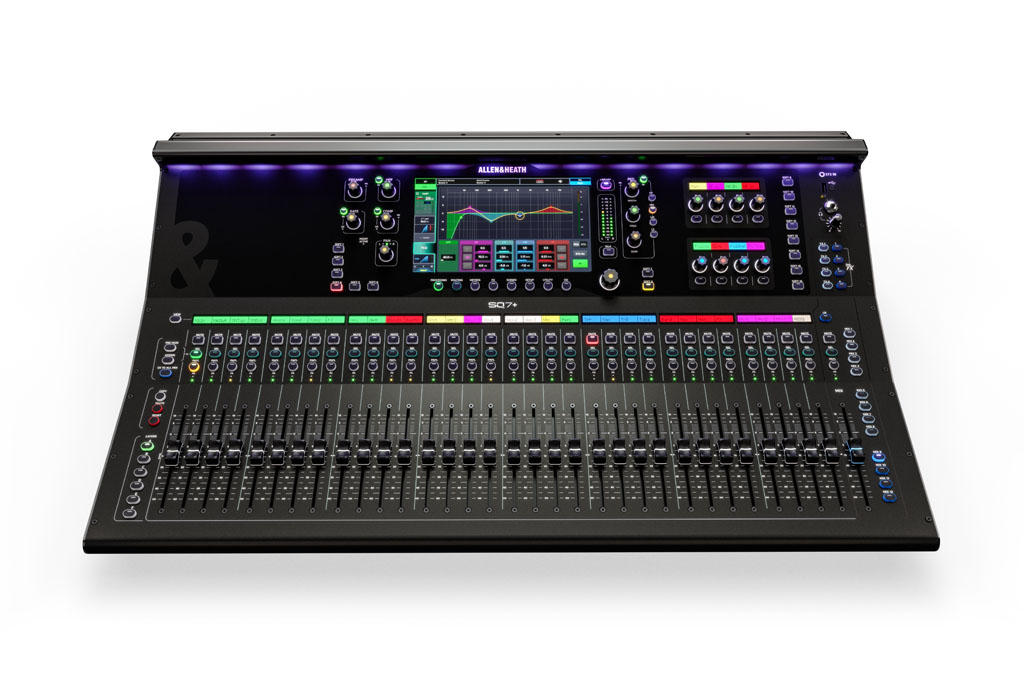
Allen & Heath SQ7+
Subscribe to CX E-News
The evolution of the SQ Platform has just taken a large leap forward. Allen & Heath has apparently listened to the feedback from its large customer base, and produced a highly-attractive upgrade to the species.
From the outset, let me state for the record that I’ve been a regular user of Allen & Heath’s SQ-7 consoles for many years now, mixing literally hundreds of live shows on this model in that time.
I’ve sung the praises of the SQ range in print, to venue owners and operators across the country, occasionally even to punters after shows – to their general bemusement. At every one of these gigs, the SQ has proven itself technically capable, utterly reliable, and sonically impressive, and I’ve consistently enjoyed the results I’ve achieved with it. That’s no small feat either, because going into this relationship, I was sold neither on the console’s attributes, nor my competency working with it. Today, I can confidently assert that all of the best gigs I’ve ever mixed live have been on Allen & Heath’s SQ-7.
The SQ is a fantastic console in many respects. It sounds great, is relatively inexpensive, logical to work with, extremely reliable, and impressively versatile. Sure, it has a few limitations that I’ve identified over time – like every console inevitably does – and I’ll discuss these here while highlighting the specs of the new SQ7+, mainly to illustrate how the new ‘Plus’ model seems to have addressed nearly all of the original SQ’s shortcomings – almost.
The Evolution of a Classic
Arguably, the steepest part of the learning curve of working with the original SQ-7 – for me at least – was getting to grips with its extensive routing architecture, scene management system, and recording capabilities. As with any complex digital ecosystem of this type, it takes time to absorb the myriad benefits a console like this has to offer before you can become expert enough to perform with it in a creative and reactive way.
With that process now well and truly behind me, I’m supremely confident working with the SQ, where I enjoy being able to work fast, efficiently and creatively.
But with the arrival of the new SQ7+ recently – I was very excited to receive it in the mail a month or so ago – I immediately became risk-averse once again; reluctant to simply dive in the deep-end with it at my next FOH mixing gig. For good or ill, I’ve always found it stressful working with an unfamiliar board in public view, and I avoid that feeling wherever I can.
Turns out I needn’t have worried.
Allen & Heath’s own spin on the ‘Plus’ range is that you can basically ‘walk up’ to the new console and mix a show – provided of course you’re already familiar with an SQ’s architecture. But I’ve heard this sort of rhetoric from manufacturers before, and I wasn’t prepared to take the risk. Old habits die hard, I guess.
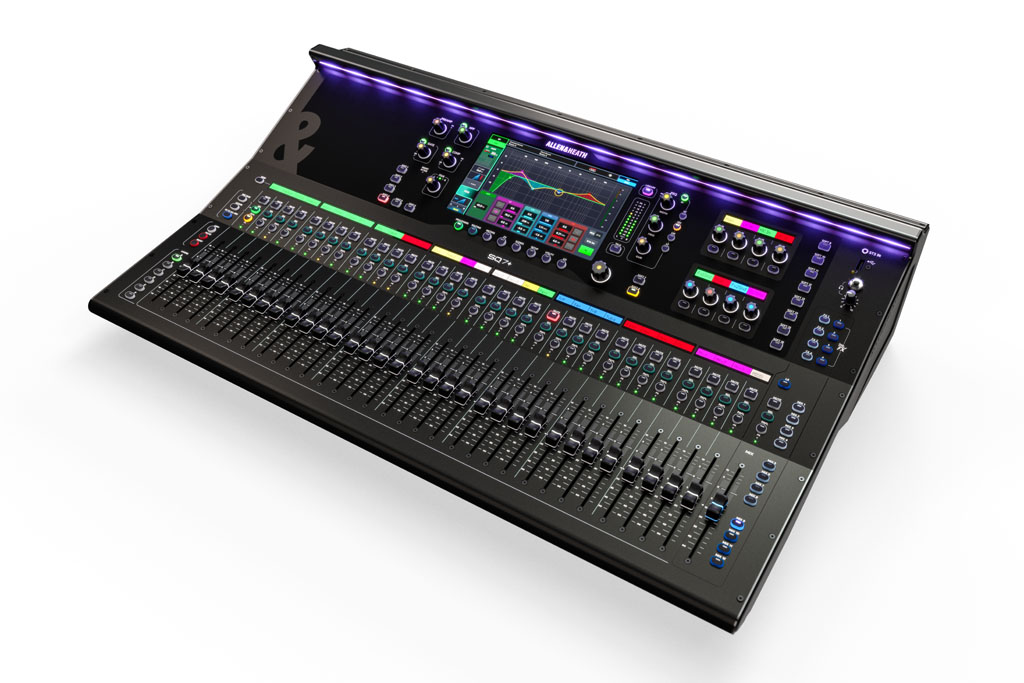
So, initially, I did some work at home with the SQ7+, meandering through its general layout and ergonomic improvements without the pressure of a gig bearing down on me. To my surprise, I immediately felt at home on the new console, and was very impressed at the outset by its layout refinements, its software improvements and darker colour schemes, the bigger hi-res nine-inch capacitive touchscreen, and the overall feel of its newer, slightly larger rotary controls and soft-switches. Even the faders and printed scale markings on the console felt less cluttered and busy looking than on the original.
Overall, the new SQ+ feels cleaner, more refined and well-conceived – a genuine evolution of the range.
But my main surprise was how familiar this console felt – the very thing I know others like me dread about any new digital console is feeling all at sea at the controls.
That’s simply not the case here. Frankly, the SQ7+ has almost no learning curve. Sure, the software looks much better and more detailed, and the console’s layout is slightly different, but when you scrutinise each software and hardware control individually, you realise there is basically an exact equivalent in almost every instance. Nothing appears to have appreciably changed.
Old Versus New
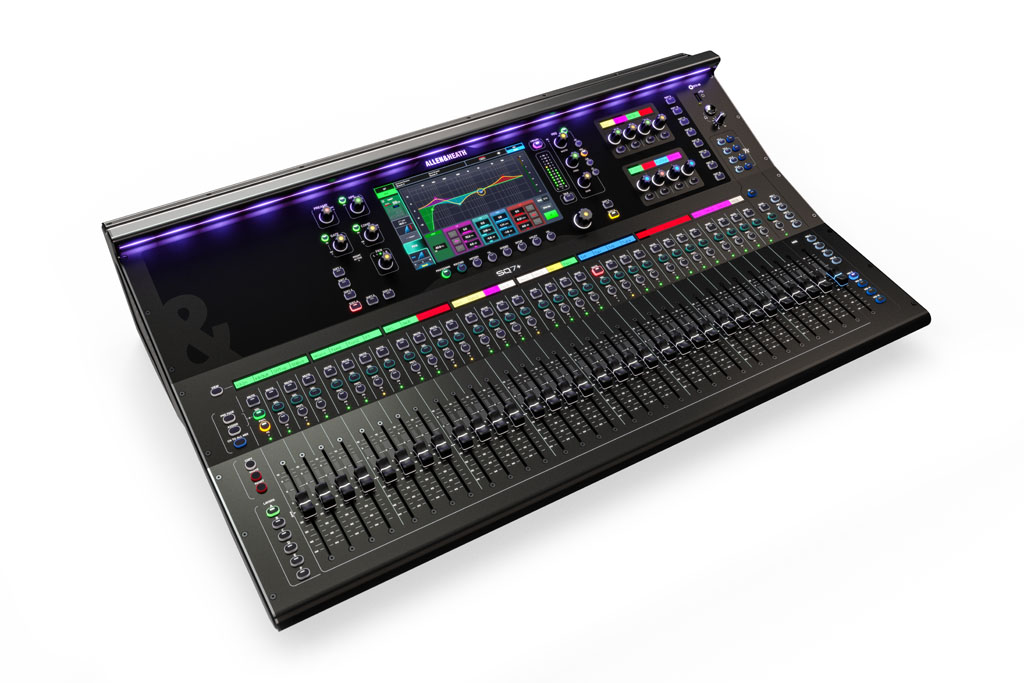
The small physical changes are something you can learn in about a minute.
The soft ‘Library’ switch is now positioned on the top-right of the main screen, directly above the meter strip. The controls for Preamp, Filter, Gate, Compression and Pan that remain to the left of the screen, are now arranged vertically, rather than in a curve, which, for me at least, somehow makes me more inclined to use them – why, I’m not so sure.
To the right of the touchscreen (which I would contend could have been slightly bigger again perhaps, at say 11-inches), and beside the aforementioned Library selector, are the three familiar parametric EQ controls of Width (Q), Frequency, and Gain, although these too are now arranged vertically rather than in a gentle curve (which I never appreciated, I must say), with selectors for each ‘band’ – Low, Low-Mid, Mid and High – switchable via dedicated soft-switches. This is slightly contentious in my view simply because any band can move anywhere along the frequency spectrum – the low-mid control, for example, can be up at 16kHz while the high-frequency control can be swept down to 60Hz. So defining them in such terms seems confusing. But I guess they have to be labelled something.
Back to the differences – gone is a dedicated ‘Flip’ switch for scrutinising the various graphic EQs on mixes via the console faders – the one change that may unnerve some users at first – although the very first soft-switch I hit whilst searching for its replacement (soft-switch 7) was indeed the Flip control. Whether that’s a factory default setup, I’m not sure. Either way, on the new SQ+ range any soft-switch can now be the designated ‘Flip’ control.
On the far right, where there were previously only four dedicated FX control switches, there are now eight, the additional four giving you access to the new RackUltra FX. More on these in a moment.
Apart from other slight improvements to the illumination of the soft-switches across the console, reducing glare, and the size of the rotary encoders, everything else is basically identical to the original, as is almost all the functionality within the various menu layers and control options. Even the physical frame is the same.
A Walk in the Park
So it’s perhaps no surprise then that when I finally took the console to one of the venues where I work, to see how many hurdles the console might throw up – safe in the knowledge that I didn’t need to mix a show three hours later – there were none.
I expected the console to possibly have difficulty addressing the two A&H DX168s on stage via the S-Link patching. They worked immediately.
Or perhaps I was going to be faced with a Firmware upgrade – there was no need. Everything sync’d up before I could even think to check whether a safe connection had been made.
This might seem inconsequential to some, but to me it was significant. Indeed, it was such a relief to me on the day that I quickly established an output patch to the PA via the S-Link output menu, stuck a mic in one of the Local channels, turned it up, and voila! Everything worked immediately. No hassles, no dramas, and most importantly, not a shred of confusion on my part about what to do or where to look – either in the menus or on the console – to establish the new connection.
As it turned out, I could have started setting up a band on stage immediately, so familiar is this console’s layout.
Software Improvements
Where the console really shows a marked improvement is under the bonnet. The new 96kHz XCVI on-board processing core manages all the tasks already familiar to SQ operators, but the console’s new and enhanced processing resources now allow the mixer to run newer generations of effects and channel processing that would have been basically impossible on the earlier hardware.
This additional power is primarily directed toward the advanced DEEP Processing and RackUltra FX, allowing the console to offer improved premium reverbs and delays, de-essers, saturators, multi-band dynamic EQs and compressors, harmonisers and amp modellers. Some of these – particularly the multi-band compressors and de-essers, which I regard as essential to good mixing these days, were conspicuous in their absence on the original SQ models, and to my frustration only available via an ‘Extras’ package. You could see them in the FX menus – they just didn’t work; like a car with a bunch of switches that do nothing, reminding you every time you drive of just what you’re missing out on.
So while the original SQ-7 supported DEEP Processing without ever really offering it out of the box, the SQ7+ is now designed specifically to support the latest generation of these models thanks to its increased processing capability.
Unusually, the console I had delivered to my door came with all the additional RackUltra FX already installed, so it was initially a little unclear to me which ones were considered RackUltra FX, and which ones weren’t. I later discovered that the new SQ+ range ships with precisely none of these RackUltra FX as standard. They’re all only available as extras, which I found a little misleading, given that the console physically names these extra FX buses on the hardware surface itself. Presumably, this being the case, you’d think Allen & Heath would ship at least some of these as standard with the console.
The consolation prize here at least is that, without the RackUltra FX installed, the RackUltra FX sends and inserts still function – albeit populated only by the ‘standard’ effects.
Package ‘Deals’
There’s a complete RackUltra FX suite for US$799, a Reverb pack (US$249), a Harmoniser pack (US$199), and a Tuning pack (US$199), as well as FX that you can purchase individually. Certainly the console has de-essers, multi-band dynamics processing and additional effects where it didn’t before, and suffice it to say there are far more standard options now, but still some of the newest premium reverb ‘spaces’ et al are only available when you buy them individually or as part of a bundle.
There’s also a ‘PlusPack’ launch bundle available right now that includes all DEEP processing and RackExtra FX add-ons for new SQ+ owners who register their mixer. How long that will be available for I’m not certain, but frankly, either way I really wish Allen & Heath would just provide all these FX as standard, or at the very least, offer the complete package to engineers via a USB ‘licence key’ that would allow them access to all the additional FX regardless of where they’re working. Frustratingly, you can only add these bundles to consoles – so where I currently use three SQ-7s at three different venues, each one requires a costly additions package, even though they’re all operated by the same engineer – me.
That gripe aside – to my ear, the new effects are amazing sounding, the premium RackUltra FX, in particular, representing a big step forward for SQ: the reverbs far more detailed and glamorous sounding than the earlier effects engines, and the additional delay options creating far more sophisticated and nuanced spaces than you could ever hope to achieve prior. There are even amp simulators now that allow you to apportion grit and grime to certain signals that might otherwise sound too clear, harsh or brittle (this represents a massive improvement to the console overall in my opinion). There’s even a saturator now that offers similarly welcome distortion characteristics.
The other gripe I’ve had about the original SQ – that somewhat inexplicably, compressors could not be added as channel inserts – is now a thing of the past on the SQ+.
What’s All The Plus About?
Overall, the software and hardware improvements on the SQ7+ are significant enough to well and truly justify an upgrade to all the SQ consoles in venues where I work! Whether that will ever happen, only time will tell. But what it indicates to me is that these so-called additions to the SQ’s ‘range’ – Allen & Heath describes the new ‘Plus’ variants as being ‘additions’ to the range rather than replacements – won’t coexist for long. The writing is on the wall for the originals. The new SQ7+ model is an amazing console, and the original SQ-7 is already looking, inevitably and by contrast, a bit old-hat.
All in all, the familiar workflow of the SQ has been well preserved and upgraded here. The result is a console that feels familiar, more capable, and better sounding.
I am supremely confident that if you were forced to ‘walk up’ to this console tomorrow and mix a gig – assuming you were already familiar with the SQ range – you’d have no trouble whatsoever. This new console nails that concept.
The improvements are everywhere, and yet somehow nothing has changed. The software seems totally overhauled, and yet it’s basically identical. The looks have been improved out of sight and yet physically it’s the exact same board.
Allen & Heath appear to have pulled off a magic trick.
The SQ7+ is an impressive evolution of the species… I’ll take three thanks.

Subscribe
Published monthly since 1991, our famous AV industry magazine is free for download or pay for print. Subscribers also receive CX News, our free weekly email with the latest industry news and jobs.