BOOK REVIEW
15 Sep 2026
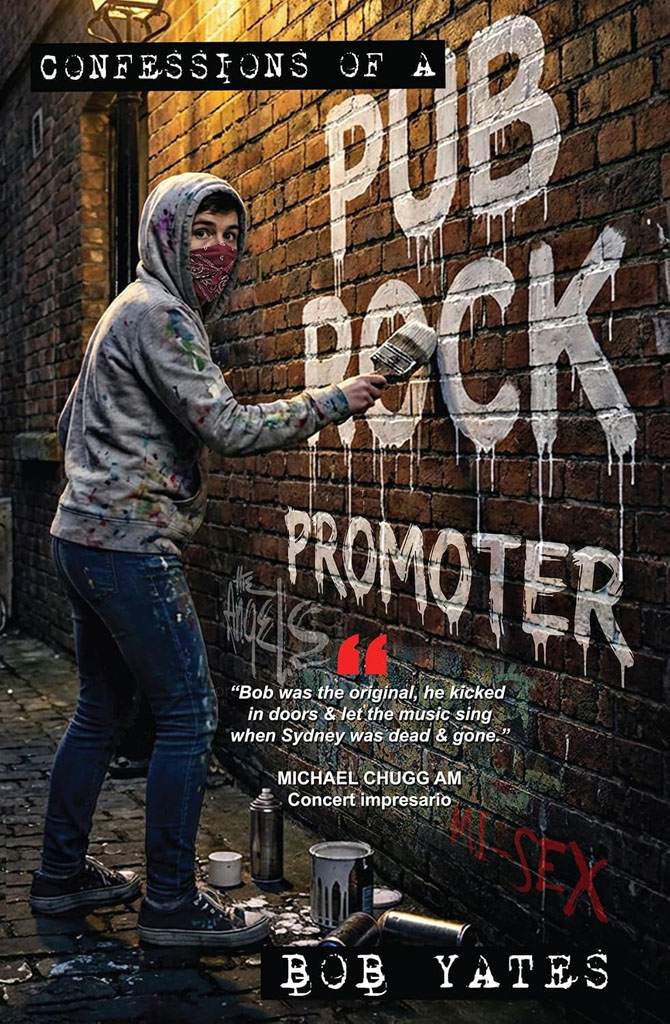
Confessions of a Pub Rock Promoter
Subscribe to CX E-News
Bob Yates managed Mi-Sex to their global heights, coming from his start as a folk concert promoter in the early ’70s and then as a pub gig promoter.
An energetic older guy in Balmain (still), he has penned a deep-dive book into the nuances, deals and daily betrayals of the seething Australian rock scene across the ’70s through to the ’90s. And what a story.
Bob kept, or hoarded, insanely useful (now) amounts of notes, diaries, contracts, invoices and paperwork, allowing him to name dates, faces, deals and dollars in a chronological journey through what now looks like the total madness of an exploding social genre.
Having crossed many paths with Bob and worked the scene, the people and places came flooding back to me like it was (telex, answering machines, diaries, receptionists) yesterday. Where is Barrie, the roadie who came over with Mi-Sex? Last seen working at Farrells Music, where Bob sprung as guarantor for a $20k finance loan to buy the band a PA.
The story starts with Bob’s music industry career, but before that he was a TV actor, starring in commercials for Deb Potato Mash (‘yum’, he says) and Codral Cold Tablets. After music, he formed ‘Bob and Pete’s Bakery’ and dominated the delivered croissant market in Sydney. Quite the entrepreneur, so starting up folk music promotion was easy.
In those early ’70s days, venues were plentiful: old halls, coffee shops, disused warehouses and, of course, the Kirk Gallery, an old church. The Kirk was a Sunday night institution run by Peter Day, but Bob was in and out, scoping artists for his shows. I did the lights.
He started managing bookings at The Civic, an art deco hotel on Goulburn Street in Sydney. Early-week residencies with artists like Anne Kirkpatrick and Mental as Anything built fast. Up the stairs, the band room was often crammed. He moved on to the Royal Antler, where a band called Midnight Oil were driving a spear into the northern beaches music scene. A young Farriss Brothers band became INXS.
And then Bob was introduced to Mi-Sex, a Kiwi band that had just arrived. They needed gigs; he agreed to book them. Then they wanted a manager. He held out and eventually signed on, minus royalties.
He was mentored by the great John Woodruff, who was at the time establishing The Angels as the number one box office band in the land. Woodruff gave him two pieces of advice that, while Bob didn’t exactly ignore them, he failed to get his management contract established early and agreed to forgo royalties. Bad mistakes.
Mi-Sex took off like a freight train in a scene featuring Flowers (soon to be Icehouse), Kevin Borich Express and upcoming Melbourne bands like the Dingoes and the Sports. Sherbet and Skyhooks had dominated the teen market, fuelled by magazines like TV Week and Go-Set. The TV show GTK was soon replaced by Countdown. Donnie Sutherland had a national Saturday morning music TV show. And colour TV arrived.

Bob tracks the band’s rise through the venues that rose out of large suburban beer barns, run by upcoming bookers like Harry Della. By then, Bob was running some pub rooms and managing the band, operating out of his Balmain house and soon buying the one next door. For $22,000!
Initially, he was impressed with the band spirit. Bass player Don Martin (RIP) controlled the money, they all lived in a ramshackle rental mansion in Darling Point, and they were strictly anti-drugs. Dragon were at the time imploding with public heroin issues; another Kiwi band, Hello Sailor, had similarly become hello failure. Mi-Sex were focused on success.
The band acquired a tour manager, codenamed Jason in the book because he is still around, and a crew of four. The tour manager came about because the crew rounded on Bob to inform him they were getting smashed with the schedule. And what a schedule it was: the band would sometimes do two gigs in one night, in an era of late closers.
The whole scene was predicated on opportunity. If Countdown called to do a Saturday shoot (for the Sunday show), every band would drop gigs to make it. And the overnighters ramped up. Out of a gig at 1.30 am, drive to Melbourne, arrive at 2 pm, load in.
They had an early wake-up call when an important gig at Bondi Lifesaver was cancelled because the truck didn’t arrive from Melbourne. It was in a ditch down the Hume. The crew were shaken but OK. And that very year Swanee lost two guys in a flaming truck crash. Crew life was precarious, and ‘the industry’ didn’t seem to care.
Bob was part of ‘the industry’: Gudinski (Mushroom) and Stivala (Premier) in Melbourne, and Chugg and Righi (Harbour Agency) in Sydney, called a lot of shots. Dirty Pool was emerging, with co-founding band managers John Woodruff, Ray Hearn and Rod Willis rolling out the ‘door deal’, with their roster of bands Cold Chisel, The Angels and Flowers (Icehouse).
The door deal replaced the flat fee: ‘3 out of 4’ was $3 to the band out of a $4 ticket. Bands put someone on the door with a sheep counter. Mi-Sex had Luke, who doubled as security. Tall, quiet, blond and 100% Hells Angel, no one messed with him.
Soon came ‘the guarantee’: $2,000 plus $3 out of $4, and the original Mi-Sex budget of $6,000 a month break-even quickly multiplied. Literally enormous piles of cash were transacted every night, at more and more venues.
They had hit singles: ‘Computer Games’ went international, and so did Bob, chasing the USA leaders of CBS Records to release their album there. While the Australian CBS was cashing in, selling singles and albums as the band cranked out hits like ‘People’, ‘Falling In and Out’, ‘Castaway’ and the power ballad ‘Blue Day’, the Yanks were a different equation.
Bob had a chance meeting with Roger Davies in LA. Davies is arguably the single most successful Australian music manager, in a short field containing Michael Gudinski and Glenn Wheatley. Davies manages Pink today; back then, he was starting with Olivia and went on to handle Cocker and Tina Turner! He counselled Bob as to the wiles and ways of the American record company scene, which in the case of Mi-Sex was a treacherous game of Promises and commitments were made and smoke was blown, but the promised release and tour support didn’t arrive. Bob had an American manager and agent with dates strapped up.
Continental Airlines launched on the Sydney to LAX route with half-price fares, so Bob funded eight grand’s worth on his Amex card.
The band were getting harder to deal with as they impatiently awaited their pathway to global success, hinging on the viper’s nest of deals Bob was muddled with, much of it revolving around competition between East Coast CBS and HQ in New York. A timing crunch arrived: the band had dates booked and were telling the music press they were about to tour the USA, but CBS reneged on the tour support.
So they went anyway on their dime: $25 grand that Don had in the bank, and Bob’s Amex with an open credit limit. It wasn’t long on the road before a cascade of badness sloshed up from the underworld: the band discovered a new (to Australia) drug called cocaine, CBS were not assisting the tour, and Amex called in the credit line, worried (I wonder why) about how a band would make payments.
There were great gigs in small rooms and large supports with ambivalent audiences, except when they did ‘Computer Games’, which was a minor hit. And friction. Things deteriorated when they returned and restarted the relentless touring grind, and eventually a combination of drugs, hubris, ego and voices in ears turned the band meeting toxic. Bob walked out. They owed him sixty grand, and he didn’t get it. He sued them. Next was a lean period managing Bushwackers and forming a partnership agency called JAM that ran diverse second-level bands.
Part of Bob’s success was his work ethic – he thought nothing of staying up all night printing, and then pasting up gig posters.
He eventually settled with Mi-Sex after setting up a two-week tour for them at the urging of their new manager, who wanted the matter cleaned up.
The book tracks the slow wind-down of the frenetic live music biz, where the ticket prices were static but the costs kept rising. History puts random breath testing and poker machines getting in the way of gigs, but economics and diversity of tastes played a part. Typical was the range of styles from punk through rock and country to the downright niche, such as Captain Matchbox and the risible, loony Tiny Tim, whom Bob promoted. I did one of those shows and it was downright weird.
Bob writes with passion and honesty. It’s an easy read, including some deeply personal episodes most writers would hesitate over. The book ends with him and his partner Pete ensconced as muffin moguls at their Marrickville factory. Seems like Bob finally found a way to make some dough after all.
Subscribe
Published monthly since 1991, our famous AV industry magazine is free for download or pay for print. Subscribers also receive CX News, our free weekly email with the latest industry news and jobs.
Recent posts