CONTROL
17 Nov 2025
NRL GRAND FINAL: SHURE VS SENNHEISER
Subscribe to CX E-News
WMAS Ushers in a New Era of Wireless Control
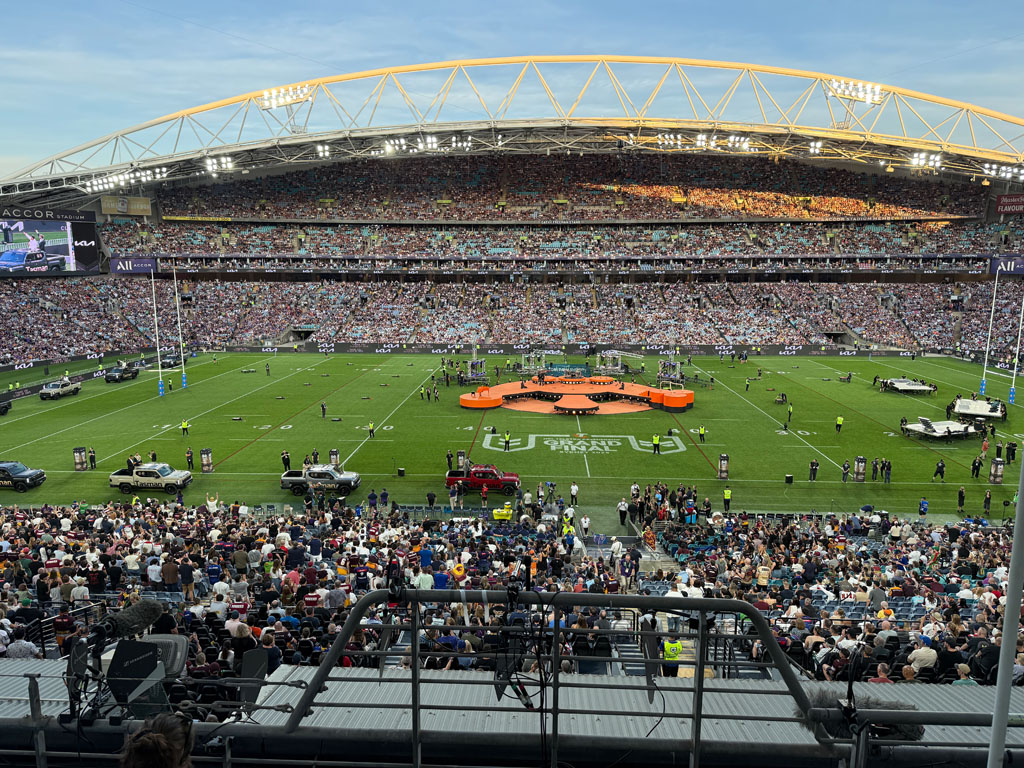
As Melbourne Storm and Brisbane Broncos squared off at the 2025 NRL Grand Final at Sydney’s Accor Stadium, there was another match-up happening behind the scenes. Fresh from having their use outdoors approved in the October 1 update to ACMA’s low interference potential devices (LIPD) class licence, Sennheiser’s Spectera and Shure’s AD PSM WMAS (Wireless Multi-Channel Audio System) wireless products were both in use at the ground; Spectera on the broadcast side, and AD PSM for the live entertainment.
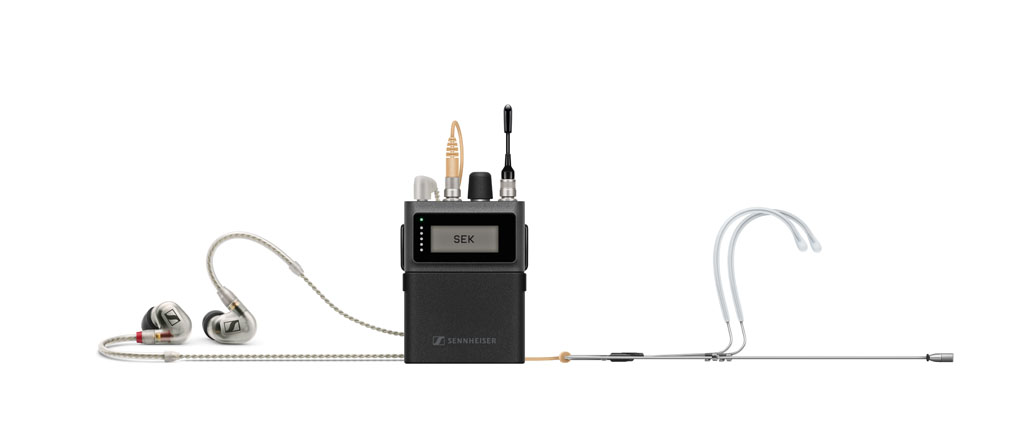
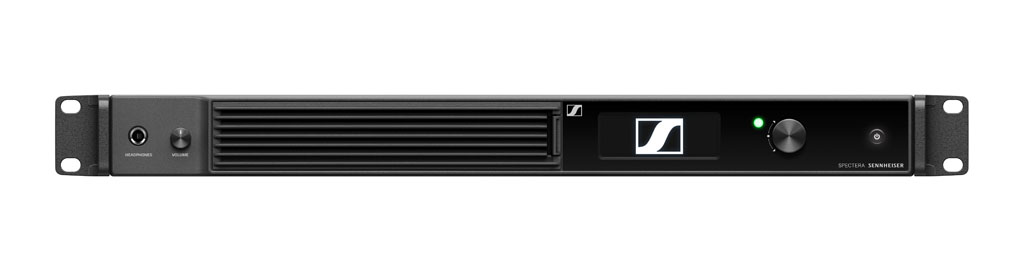
Sennheiser’s Spectera, which can use two blocks of 6MHz of spectrum to run up to 64 channels of wireless audio and device control from a 1RU base station, was used by outside broadcast provider NEP on the stadium’s forecourt to run live broadcasts of Channel Nine’s Today Show, Wide World of Sports, and The Footy Show.
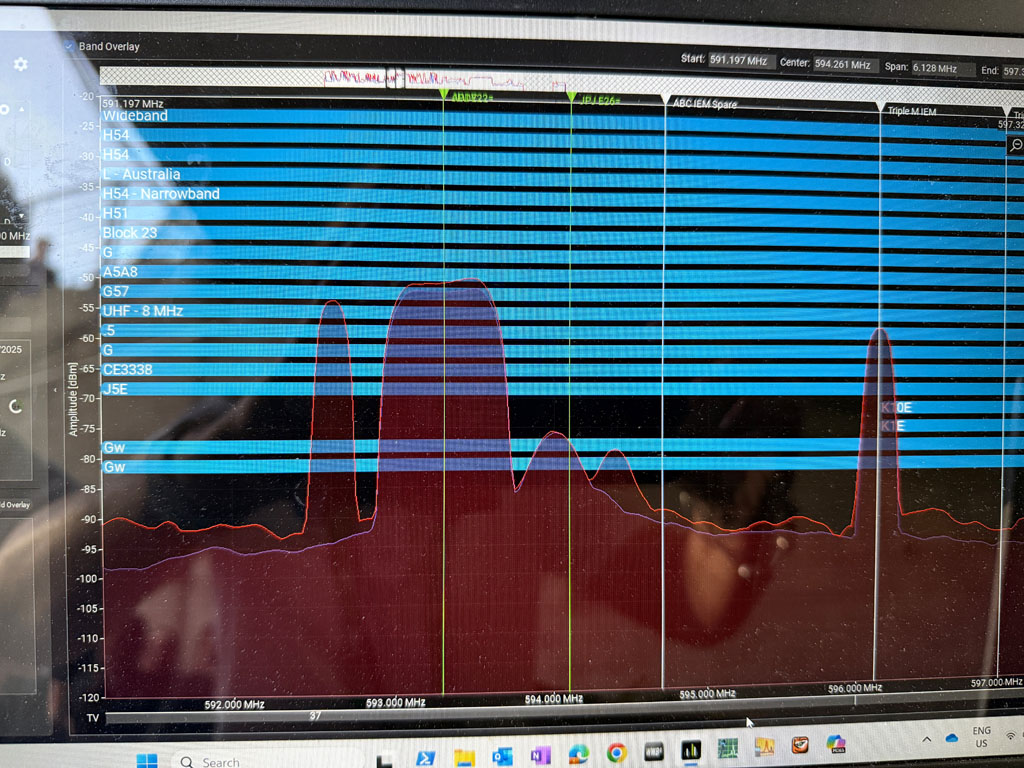
On the ground, Shure’s AD PSM personal monitoring system was used to provide in-ear monitoring for pre-match entertainment Teddy Swims and their crew. Two units with quad transmitters ran in Wideband Mode (WMAS), sending our four stereo sends each. A dual transmitter sent out two stereo sends in Wideband, and a second dual transmitter ran in Narrowband mode to send a stereo send to the monitor engineer.
The RF referees, Susan and Peter Twartz of Profiles RF Management, had just come from the AFL Grand Final the week before, which did include Shure’s AD PSM in-ears system, but not running in WMAS mode as outdoor use was not permitted under the previous LIPD. They were responsible for organising and policing the astonishing numbers of wireless products and their frequencies that are used on both grand finals.
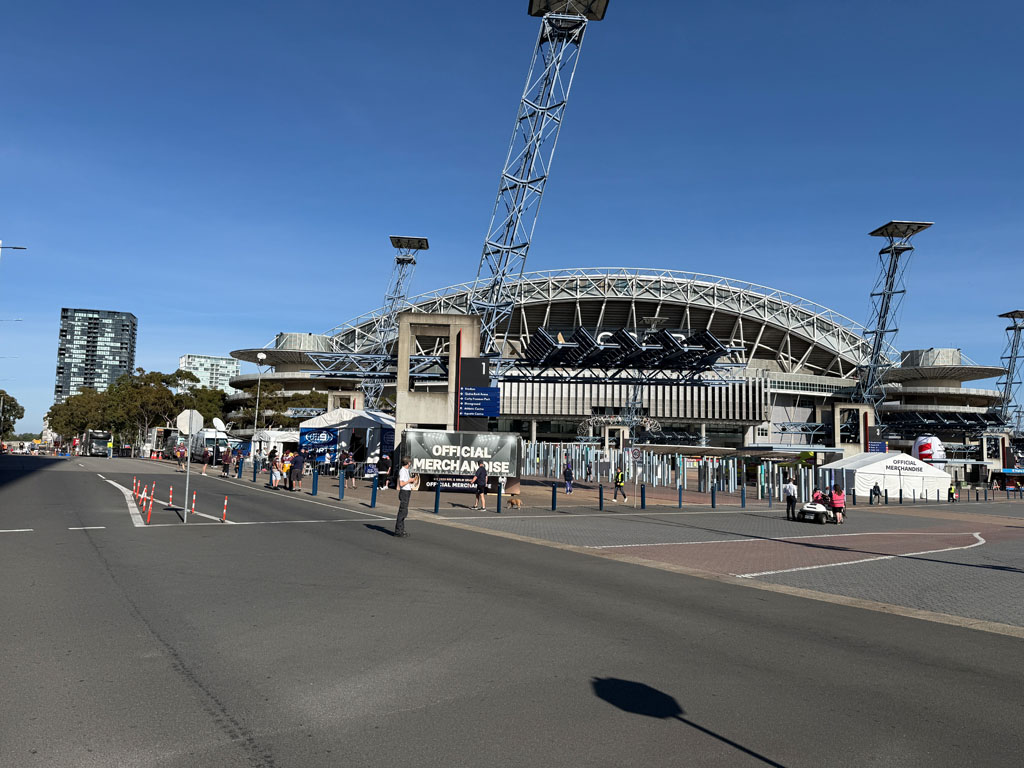

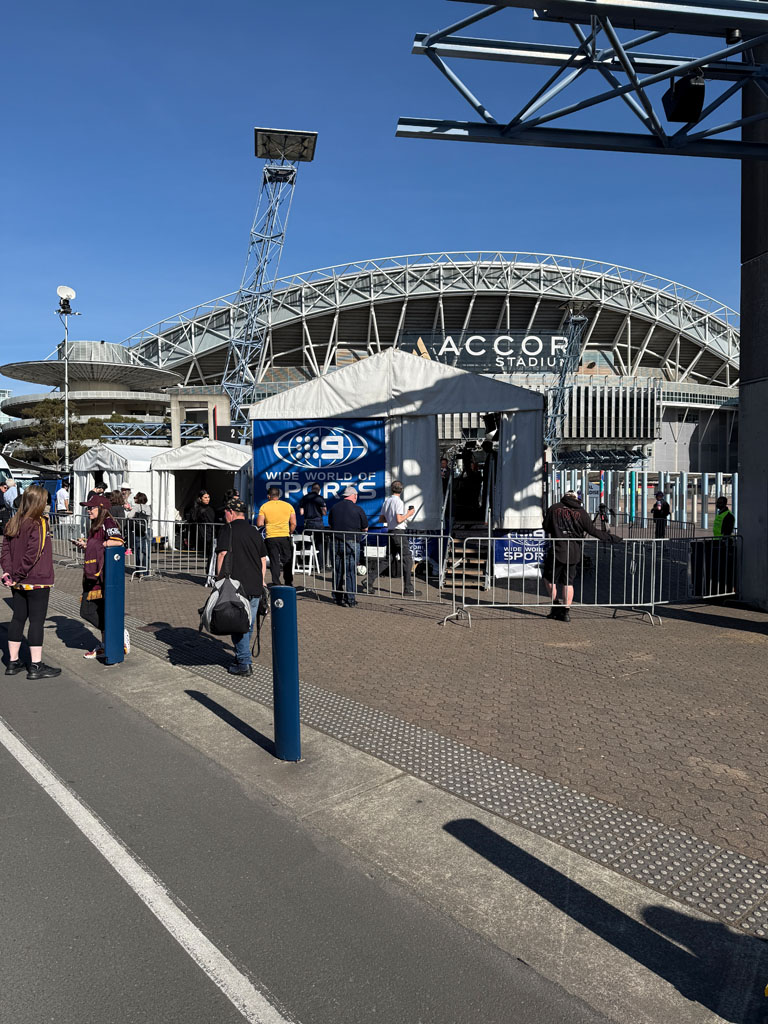

“NEP were operating Spectera from 6:30 am until 1 pm, by which time, inside the stadium, they were already playing and broadcasting football matches,” says Susan Twartz. “There was a state championship game, followed by the women’s Grand Final, followed by the men’s Grand Final.” NEP were using eight of Spectera’s new beltpacks, which are both transmitters and receivers. They handled the presenter’s headset mics, as well as their IFB (Interruptible Fold Back) monitoring sends.
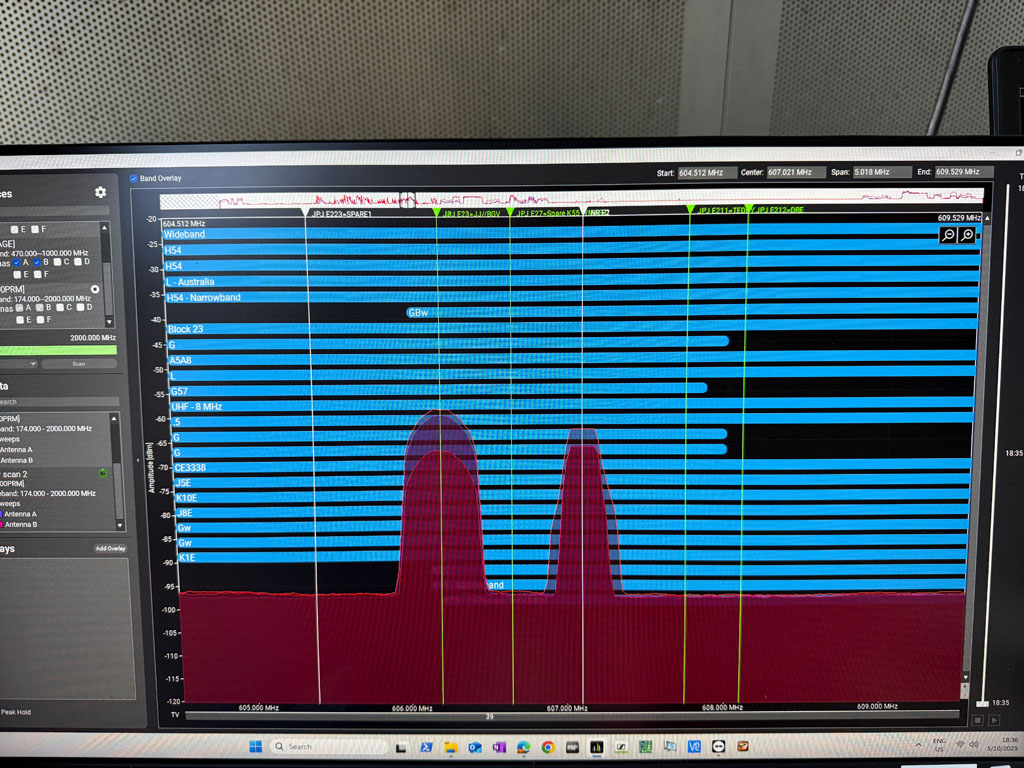
Most of Profiles RF Management’s work on these mega sporting events happens way before the day, mapping out frequency allocations and spectrum usage. “There was a discussion, and I agreed with NEP that using Spectera in that application was a good idea,” confirms Peter. “I put 6MHz of spectrum aside for them, with a spare 6MHz of spectrum for backup. We tested both and stayed with the first one.”
“Finding a 6MHz spectrum hole is not easy, but finding a 6MHz hole at the beginning of the process is relatively straightforward,” Peter continues. “Knowing that that was part of the requirement in the plan, I allocated those two 6MHz holes 10 days ahead of giving frequencies to other people and then kept them clear. Finding holes for 16 frequencies later in the game is far easier than finding one 6MHz hole late in the piece. If you’ve already allocated lots of frequencies, and somebody then comes at the last minute asking to use Spectera, then the answer is ‘no’. I’d have to move a dozen other people that have already been given their frequencies.”
Spectera has, from a frequency perspective, only one mode. It takes up 6MHZ or 8MHz of spectrum here in Australia, which is the width of one TV channel; in Europe it’s 8MHZ. Within that spectrum, Spectera sends broadband data, including control and audio. No matter how many packs and channels you’re using, it always occupies 6MHz of spectrum, regardless of how many audio and control channels you are actually using.
Shure’s AD PSM operates quite differently. In Wideband Mode, it transmits in multiples of 800kHz. Each 800kHz can carry four stereo signals, and you turn on as many as you need. “The Shure AD SPM system was good spectral use,” observes Peter. “Finding 800kHz of spectrum was easy, and getting four stereo sends in it was good. If we’d been using Shure PSM 1000, in 800kHz, you’re lucky to get two stereo sends.”
In addition to enhanced channel counts and easy management, built-in antenna diversity increases range. “From a range perspective, it depends on the environment,” Peter adds. “800kHz is robust. For Teddy Swims, the transmitters were out on the stage, so range was just not an issue. The downside was that until the gear went on the field and powered up, there was nothing there reserving the frequency. I was very actively monitoring the gaps as the stage pieces rolled out onto the field, and until they got out there and powered up, they were just empty bits of spectrum.”
With two totally different approaches to implementing a new technology, how do they sit in the market relative to each other? “I see a relevant application for both products,” Peter muses. “From a frequency management perspective, if I know in advance I’ve got to provide spectrum for Spectera, that’s fine.
Somebody suddenly announcing they want to use Spectera at the last minute is fraught with challenge. I suspect that where the market will go is that the concert and entertainment market is going to use Shure AD PSM and the broadcast and theatre market is going to use Spectera.”
“In broadcast, most talent are wearing head worn or lapel mics, plus ears for IFB,” adds Susan. “The other thing is that Spectera offers a totally different workflow. At the moment, when broadcast arrive at site, the first truck has all the equipment in it, and it arrives before the OB truck. The first thing they do is unload a rack full of wireless and wheel it into the stadium. It might go up on the camera platform, or it might be down on the sideline. That rack of transmitters and receivers then gets its antennas cabled out. With Spectera, because the connection from the antenna to the brain can be over fibre, there’s no reason for the brain to go into the stadium. The brain can live in the OB truck with the audio connections permanently patched. The Spectera antenna paddle is actually the radio receiver, and what comes in and out of it on Ethernet is bidirectional signal and control.”
“Fundamentally, each product is very much the same, but how each manufacturer has implemented what’s a very similar RF concept is entirely different,” agrees Peter. “And both are quite appropriate to their respective markets. Shure have produced a product that the top end of the touring market has accepted immediately. The same is happening for Spectera in broadcast.”
On The Ground – Sennheiser Spectera
Alex Wong is the Senior Audio Supervisor for NEP Australia, and was Audio Director for the NRL Grand Final. NEP’s Phil Agnew was the operator on the day, with Alex responsible for programming and set-up. “NEP has been part of the Sennheiser Spectera pilot program, and we’ve been testing the Spectera system for six months now, indoors.”
“At the NRL Grand Final, we had Spectera running DPA headsets and IFBs. We had eight packs there total, with four in use at any time. We’d have four live, with four for guests prepping on the sidelines. We wanted to use Spectera because it allows us to get guests up and running easily on a single pack. Previously, it’s been two radio mic packs or more for each guest. That makes it a bit harder, because we have to juggle more frequencies, packs, and hardware. Using Spectera to do exactly the same thing makes the workflow much, much, easier. It’s also a lot easier to manage and test before we even get on site.”
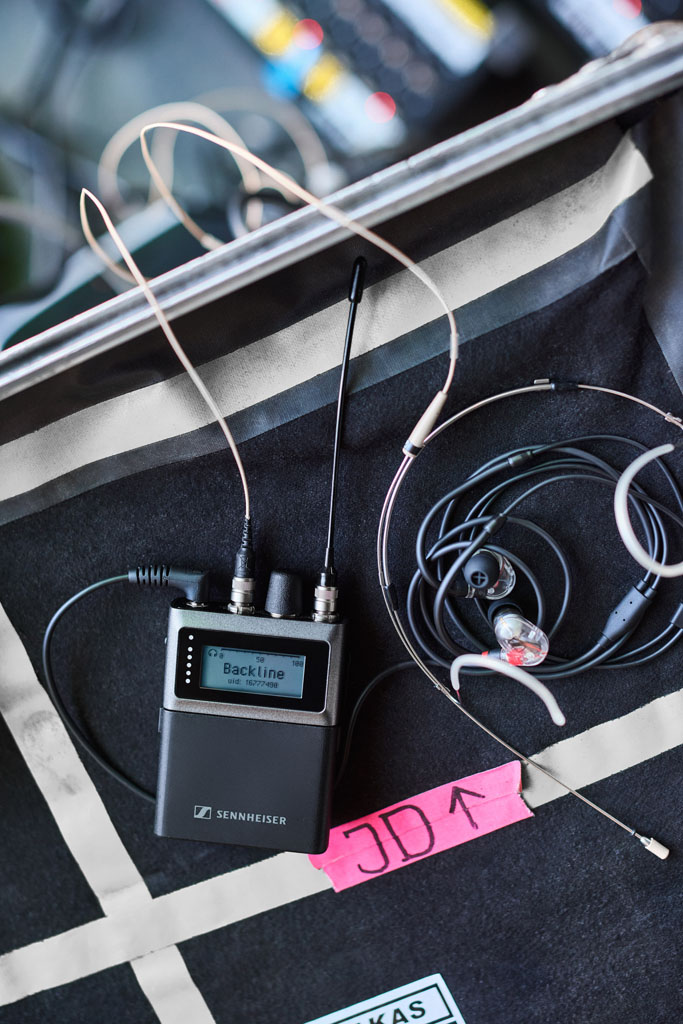
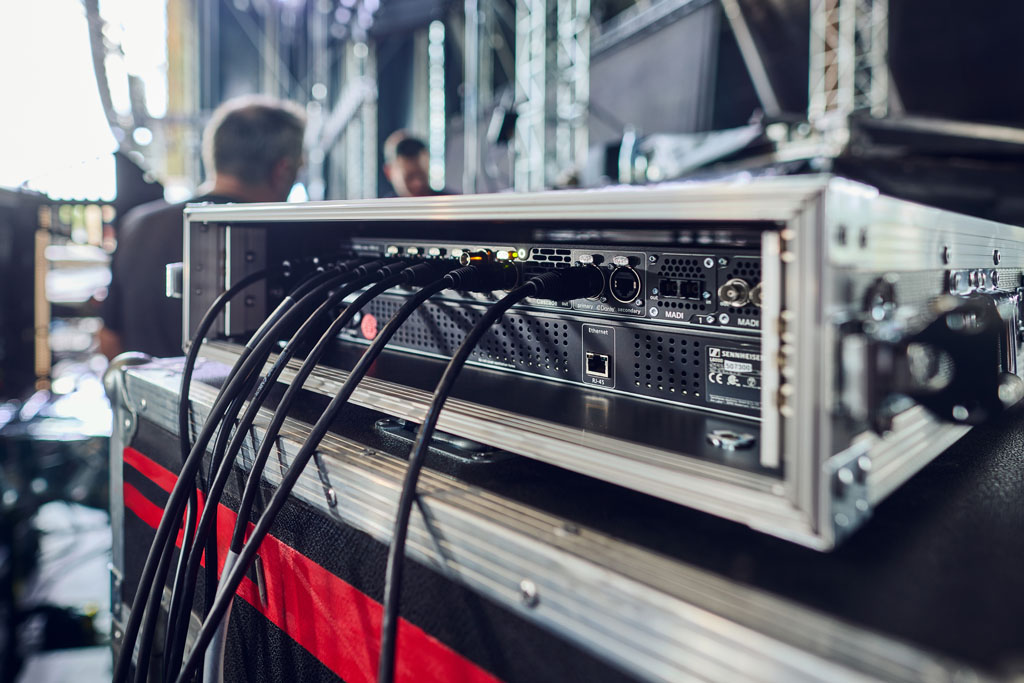
When NEP do get on site, the workflow improvements continue; “One of Spectera’s big strengths is that it’s a very quick system to deploy,” says Alex. “We were using Dante at the NRL, but we’ve also used the MADI I/O. We’re down to a couple of Cat5s to get it into the audio console, and it gives us a lot more redundancy than we’ve had in the past. Even though it’s one base station doing all the work, we get dual power supplies plus main and redundant signal flows. When we get on site, all we’re doing is running out a single Cat5, putting an antenna near the stage, and another to cover the crowd area, and that’s it. It’s all powered off the base station. It changes the workflow completely. You spend a lot less time building and getting it to work, and more time fine tuning and making it sound good.”
With everything running on data, there are no more RF cables to manage. “It’s very flexible, because we can convert it to fibre and then we can run an antenna anywhere. We don’t have to worry about RF cable, and all the traditional things like signal loss, and different cables and cable lengths. It actually feels a little like you haven’t done enough work. You set it up, it’s up and running, and you feel like you should be spending more time dragging cables around.”
Workflow improvements are great, but what about the all-important sound quality? “The IEMs, especially in stereo, sound like they’re cabled,” enthuses Alex. “It doesn’t sound like a radio; it sounds amazing. The mics sound much better than the previous systems we’ve had. It doesn’t feel like there’s any compansion, they just sound a lot more natural and dynamic. The feedback we’ve had from the talent is they don’t struggle as much to hear and didn’t have to turn their IFB up as far as they normally would.”
Management has also become easier, creating more peace-of-mind. “You can see on the web UI or the application if the packs are getting into an area where the signal strength drops off, but it readjusts itself and comes back up. It’s a very intuitive, quick system to learn. Being able to monitor and control in the truck, adjusting gains, seeing all the frequencies, the battery levels, and even seeing when there’s an earpiece plugged in or not, takes a lot of stress away.”
Alex sees a big future for Spectera in NEP’s projects. “It’s the first time we’ve felt comfortable putting the base station in the van instead of the field. Australian summers are pretty hard; sticking big processors out in the sun’s probably not the best. It also opens up other improvements to workflows, where we can stream directly to and from the hub, straight out of the box. Depending on the job, we might go through a local mixer to generate some real-time in-ear mixes. But for some jobs, we just do mix minus, and that could be a box that sits on the other end of the network on the other side of the country, and we just stream directly to it.”

On The Ground – Shure AD PSM
Chris Skin is an Audio Systems Engineer for JPJ Audio and was responsible for the entertainment and presentation wireless on the day; “We did all the mics for sports presentation and the performance leading up to kick-off,” explains Chris. “Included in that was Teddy’s Swim’s main and backup mics, which we ran redundant with two separate units. There was a separate set of ears, which we had as a remote set-up on field. They transmitted from behind the stage straight at Teddy, and were just for him. We had our sports presentation wireless elsewhere. All the Shure AD PSMs were set out in the centre of the field, receiving their input via analog outputs from Yamaha RIO racks connected to a Dante network. In terms of spectrum allocation, PRM looked after that for us, and we used two of the modes which the AD PSMs provide; Narrowband, which we used for the monitor engineer’s cue pack, and Wideband for Teddy’s ears and his band. The connectivity, flexibility and integration of this new tech was seamless.”
Shure AD PSM already has more options on the market than Sennheiser, with both dual and quad channel transmitters available. Both have antenna diversity built in. “It’s great that it has diversity, but we didn’t really use it to its full potential at the NRL,” relates Chris. “We only had one antenna set up, whereas we could easily have had two or more, if Teddy was entering from another end of the field, for example. Looking at the different modes, there’s so much you could do with it. They’re so flexible; for example, in a stadium show, you could have your artist walking in from the dressing room with an antenna shooting down there, and one facing the stage, and you’re covered, without having to run everything over fiber.”
Chris sees the real advantage in the workflow improvements; “The great thing for us was the ease of setup and the seamless frequency management. With Shure’s ShowLink control, we are now able to reset things like gain or frequency and not have to re-sync the packs all the time. It’s fantastic for making our busy, busy day easier; I’ve already got a million other things to look after! If anything needed to change, we could just punch it in and it goes seamlessly straight across to the packs, and we can hand out the pack straight away.”
And how does the new system sound? “It’s night and day compared to the previous flagship IEMs; they’re incredible,” praises Chris. “You can tell the difference straight away, and it sounds like they’re wired. The talent is saying the same thing.”
Chris agrees with Peter Twartz that Shure’s AD PSM will be quickly and widely adapted by the concert and touring market. “Sound quality, workflow, ease of use, peace of mind, saving rack space and weight, it’s all a massive thing for us. Widespread adoption is not going to take long once people start to get comfortable, and with Shure, it’s all run by the same Wireless Workbench software we already know.”
Subscribe
Published monthly since 1991, our famous AV industry magazine is free for download or pay for print. Subscribers also receive CX News, our free weekly email with the latest industry news and jobs.