LISTEN HERE
12 Oct 2026
‘Define ‘Human Error’
Subscribe to CX E-News
Will music in the near future be utterly devoid of imperfections, or will human errors and idiosyncratic performances be embraced and celebrated? I guess that all depends on whether we’re willing to take the reins again.
When I think about how we apply the concept of ‘human error’ to music production today, frankly, I don’t think we give the term anywhere near enough thought. If we did, I suspect we’d do things very differently.
In the course of our day-to-day studio productions – working with our DAWs of choice – we’re far too easily convinced by the ‘errors’ our software flags: that a drummer’s timing is out, a singer’s pitch is off, or the latest obsession… that a sound is too resonant. Our software’s compelling visual representations of how far something has ‘strayed’ from a prescribed ideal create a powerful – yet insidious – incentive to ‘correct’ these supposed problems without thinking.
But should we?
A drum hit appears on screen before the gridline, a note ‘looks’ 14 cents sharp above the line of middle C, a guitar has a harshness at 4kHz that’s graphically illustrated in red – all of this is presented by our software as ‘imperfect’. Armed with this apparently unequivocal information, we’re then left to decide whether to ‘fix’ these inferred problems, or allow AI software to correct them automatically.
In 2026, we seem increasingly inclined to proceed directly to correcting these so-called ‘faults’, often without giving the decision a second thought, let alone questioning its artistic merit. Over the course of a song’s production, we might make 1,000 of these corrections, or allow AI to do the work for us on a per-sample basis – literally millions of times over the course of a song.
Is that song production, or wholesale manipulation of humans by our own tools?
At the same time as we’re presented with literally thousands of visual cues indicating everything from a sharp vocal and a mis-timed drum take to a spurious resonance in a lead guitar, not once does our DAW suggest how ‘great that vocal sounds’, how ‘amazingly sad’ it seems, how brilliant that drummer’s ‘feel’ is, or how unique that guitar tone sounds. This sort of scrutiny is entirely absent from our DAWs.
Our software knows precisely as much about emotion and idiosyncrasy as a gnat knows Greek philosophy.
I don’t expect my Pro Tools software to offer up any of these subjective, artistic opinions, of course. No sane person would. But remaining conscious of this – that our software will not, and cannot, offer a subjective opinion about anything – is a crucially important concept for a producer, engineer, or musician to remain mindful of. It’s important for the flesh in the room to remember that our software is not comprehensive at all – despite what you might hear. It is NOT capable of doing everything for us… not even close. It can only do certain things well… some things very well. The rest, it hasn’t the faintest clue about.

If you were to ask the gnat to describe the basic tenets of Plato, it would just stare back at you with its compound eyes. The same is true of a DAW.
Ask Pro Tools whether that vocal take felt sad beyond words or happy, and its cursor will just blink endlessly, awaiting your next keystroke. From this perspective, Pro Tools – like the gnat – is dumber than a bag of hammers.
So when we work on productions over the course of a given day, reacting only to visual cues of waveforms laid over tempo maps, pitch anomalies on chromatic scales and frequency responses represented spectrally in real time, we sometimes forget that there are other frames of artistic reference to consider here. The information your DAW provides is barely half the story, certainly not the whole story.
When We Started ‘Seeing’ Sound
It’s actually one of the forgotten differences between the digital age and the Jurassic epoch of analogue recording. One was almost exclusively aural – the visual cues were everywhere, but they were scattered and far less dominant in every aspect of a song’s production.
When we couldn’t see all this information on a giant screen right between the speakers, all we really had were our ears to determine what fell within our tolerance of good, bad or indifferent. Sure, we had VU meters and goniometers, and some of the outboard gear even had digital screens – crazy – but this amounted to a relatively tiny amount of information compared to the relentless deluge of visual cues perpetually bombarding us today. The studio computer, if there was one, was merely a component of a larger system, not the system itself. It was primitive and monochrome, and the information it provided was laughably small by modern standards.
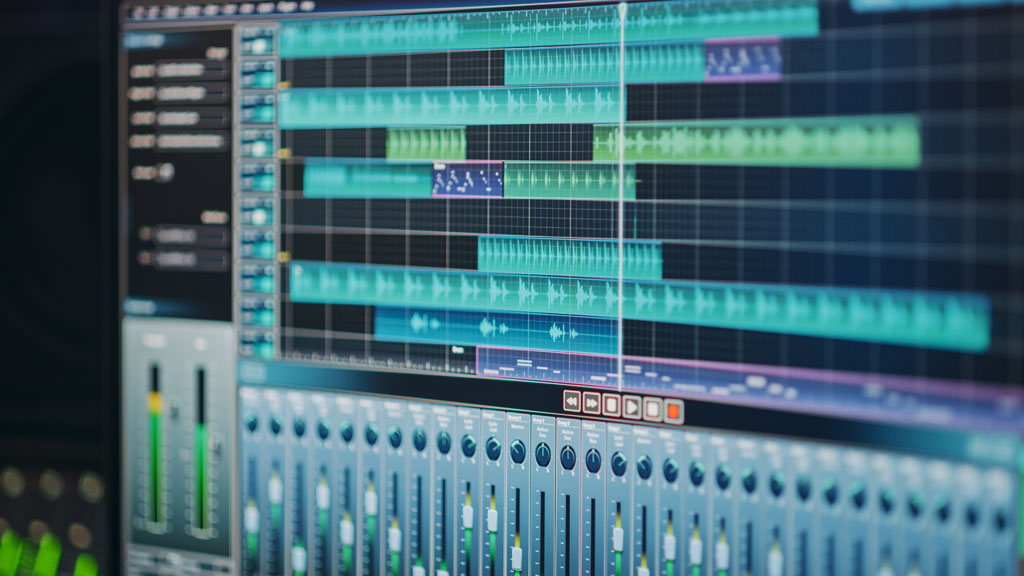
Today, by contrast, computers flood the control room with information about every conceivable thing, including illustrations of all our ‘human errors’ – without ever defining what constitutes an error in the first place.
The Error of Perfection
So what then is a ‘human error’ in the context of record-making anyway, and has our definition of it changed since the rise of the DAW?
It’s easy to view the history of music technology in starkly black-and-white terms – the romanticised past of raw human performance recorded on tape without interference, contrasted against the sterile present of machine learning, tempo maps and pitch correction software.
But the reality has never been that clear-cut. Long before the DAW emerged, the analogue domain was already filled with engineers and musicians aggressively chasing mechanical precision. We tracked to unyielding clicks, built songs around drum machines and sequencers, wrestled with some of the earliest forms of console automation, and in some cases literally took razor blades to two-inch tape, cutting out tiny physical windows just to manually nudge a rogue transient into time.
So it’s a naive misrepresentation of music history to suggest that this obsession with perfection is somehow new. We’ve always tried to iron out the mistakes, timing slips, pitch issues and performative flaws in pursuit of the best possible outcome for a song.
In that respect, arguably nothing has changed. The difference today lies entirely in the effortless nature of the process.
In the past, correcting an error required immense physical effort, hard-earned tactile skill, and crucially, the economic luxury of time to spend fixing things. What changed wasn’t our artistic goals, but the frictionless power of the software, which finally allowed us to proceed without giving the process a second thought. Apart from the tools themselves being vastly more capable, there was no risk, no damage done, and everything was reversible. Not only could you undo your handiwork with a single keystroke, you could even go back in time days or weeks if you felt like it.
Three or four decades ago, this would have been utterly absurd to contemplate.
Fast-forward to the present day and AI can now swallow an entire text prompt and spit out a fully mixed stereo master in seconds flat, which seems in equal parts terrifying, demoralising and, in some respects, fatal. It’s also easy to look at this trajectory and slip into the comfortable caricature of the cynical, bitter industry veteran launching a generic tirade against the machine. But that misses the point entirely. This is a story about a systemic trap of our own making. We’ve reached a juncture where the machine isn’t taking over because it’s exceptionally clever. It’s taking over because we (a) let it in and (b) can no longer afford the time it takes to be human.
Over the last two decades, the music industry’s financial model completely collapsed. Budgets shrank to a fraction of what they once were, and today you simply cannot spend three days riding a vocal fader or time-aligning a drum track by ear when the client is only paying for a fraction of a day’s work. To stand on pure, manual principle is a creative luxury that, with very few exceptions, leads straight to bankruptcy.
This completely changes the definition of ‘Human Error’.
In a modern economic landscape, a human error isn’t a flat note, a phase issue or a rushed transient anymore. A human error is taking too long.
But this is exactly where the narrative gets muddy. It’s easy to romanticise the era of spending days riding a vocal fader, but we have to ask ourselves: who actually owned that luxury? It wasn’t the artists. That slow, meticulous process only existed because major record labels were pumping millions of dollars of unrecouped debt into a tiny, exclusive handful of commercial facilities. The old way wasn’t inherently better or more holy; it was just an elite, heavily gatekept aristocracy.
The fact that a laptop can now time-align a drum kit in 12 seconds instead of 12 hours means an independent artist working with zero budget can actually record, mix and release a sonically competitive record without a corporate gatekeeper’s permission. The tools didn’t destroy the art form – they dismantled the tollbooth. And frankly, it’s the reason I’ve been able to pursue this art form for the last 40 years.
A computer algorithm aligning a transient doesn’t automatically suck the soul out of a performance unless the person at the helm lets it. A compelling song still cuts through a mix regardless of how fast it was assembled. The machine isn’t a villain that stole our craftsmanship out of spite; it is simply a mirror of the modern world.
The Trap We Built
This brings us to the ultimate, bittersweet punchline of the modern audio industry. Generative artificial intelligence and big tech platforms didn’t conquer music by force. We laid out the red carpet, polished the faders and invited them right in.
For a quarter of a century, the audio industry writ large systematically removed every trace of human friction, personality and unpredictability from the recording process because the clock was ticking and budgets were dying. We proudly automated the timing, the pitch, the clip-gain and the arrangement blocks to move faster and stay under budget. In short, we transformed music from a messy, emotional human event into a pristine, predictable, highly structured grid of digital data.
So when it finally breached our virtually non-existent defences recently, arguably the most surprising aspect of early AI-generated music was that it sounded more like a natural progression than a seismic shift – even better, some were saying! Musicians and engineers were collectively somewhat shocked by this, but they shouldn’t have been.
We have spent years designing a vehicle that could drive itself to save us time and money, and now we’re surprised that it doesn’t require a driver at all.
The evolution from the rigid hardware limitations of early Pro Tools to infinite, god-like native processing power is an undeniable triumph of human engineering. The software we use today is a stable, robust marvel capable of mathematical miracles. But as we stand at this particular juncture, the warning has nothing to do with code. It is an honest observation of what happens when the facilities at our disposal do all the work for us.
If we want to save our craft, we have to stop treating our own nature as a mistake that needs to be ironed out. We have to look at a beautiful, unquantisable, imperfect human performance, pull our hands back from the software and flatly refuse to define it as an error – even if it takes a little longer.

Andy Stewart owns and operates The Mill in Victoria, a world-class production, mixing and mastering facility. He’s happy to respond to any pleas for pro audio help … contact him at andy@themill.net.au
Subscribe
Published monthly since 1991, our famous AV industry magazine is free for download or pay for print. Subscribers also receive CX News, our free weekly email with the latest industry news and jobs.