BACKSTAGE
25 Aug 2026
Who Are You?
Subscribe to CX E-News
A whimsical musical analogy, preaching from my chair
In 1978, Pete Townshend and The Who asked the question “Who are you?” Allegedly inspired by a night out on the turps with a couple of the Sex Pistols, it became The Who’s biggest hit.
Have you ever stopped long enough to ask yourself, “Who are you?” Not the superficial titles of job, marital status or pronoun – I mean the deep-down you. Who are you emotionally, intellectually, societally? If your life were a musical composition, what would it sound like?
What’s your scene?
Born to an avid musician, I was introduced early to both the joys and grind of music. Joy in tinkling ivories, joy in bashing pans, but grind in endless scales and pain from turgid theory lessons. I just wanted to play 12-bar boogie on the pee-annah and smash around a drum kit like Animal from the Muppets. But no, this week it’s A major: A, B, C♯, D, E, F♯, G♯, A … and repeat. Then on to Bartók – forevermore a swear word in my head!
If that were not enough, I’d go home from lessons to the widdly-diddly-dee of bush jigs as my dear Ma practised with her bush bandmates. Whose gigs we were dragged along to, whether we liked it or not. While many thoroughly enjoy this genre, my upbringing has soured that taste.
Though I studied piano and percussion formally, that was aeons ago, and I’m already batting way above my average talking anything beyond basic music theory and associated anthropology. Let’s dive in anyway…
Western tonal music is set in a key, as the most common pitch in that composition. It has a specified tonic pitch and mode of major or minor. The 12 pitch classes are commonly reduced to seven ‘natural’ pitches – A, B, C, D, E, F, and G, each representing one octave. Phew.
Other geographic and cultural groupings have produced their own ways of making music. Much Middle Eastern music runs on the Arab tone system of 24 tones to the octave.
Chinese music can also be broadly broken down into 12 pitches. But they do it a little differently, with pentatonic scales and wolf intervals. Africa has as many musical styles as its diverse cultures. Polyrhythms feature heavily, call-and-response playing abounds and I’ve heard amazing harmonies emanating from this region.
Essentially, all music is designed to produce an emotional response from both player and listener. This can be happy or sad, upbeat or melancholic, soothing or confronting, or whatever mood is sought. While a casual listener’s response may be challenged by anything outside their ethno-cultural box, enlightened ears will find great feeling and sentiment in all genres.
Emo is not a dirty word
Music can make you happy or sad. It can make you think or help you to not think. It also makes a career for so many of us. If the act you work with makes you sad, remember payday. If that also makes you sad, it may be time for a key change in the song of your work life.
Most of us work with popular music, which is usually very predictable. Intro hook, verse, chorus, verse, chorus, breakdown, verse, chorus, chorus, out. All in a major key with an easy 4/4 or 2/4 to bop along to.
It’s this time signature that originally had me musing on song as life. When establishing a meter to live by, I see 4/4 as predictable, steady, and easy to find ‘the one’ – that’s why it is so popular in the West. 2/2 people are more tribal, rhythmic, and may enjoy marching (L-R, L-R, L-R…). The dapper folks waltz or swing in 3/4 and this triple meter is common in formal dance music, ballads, and classical.
Orchestral lovers get to enjoy a whole range of tempos, keys and moods.
The weirdos like me get their kicks from compound or complex timings and structures. 5/4, 5/8 and other quintuple meters are appropriately off-tap. Zeppelin’s The Crunge rolls along in 9/8, as does Brubeck’s Blue Rondo à la Turk (before switching in and out of 4/4). The Allman Brothers’ Whipping Post starts in 11/4 before trying 3/4, 12/8 and more. Serial tempo explorers range the eras from Stravinsky, to Boulez, Zappa, King Crimson, King Gizzard and the Lizard Wizard, and most recently Angine de Poitrine.
The polyrhythm of life
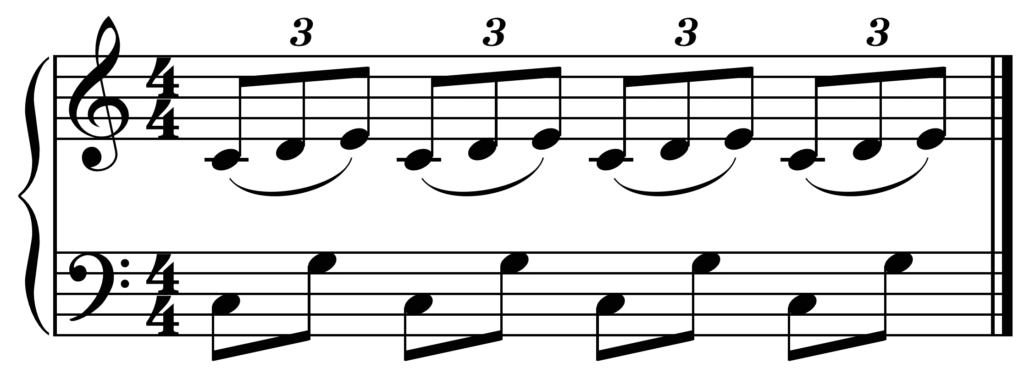
There is a joke going around that Meshuggah is the only gig where five people can headbang in different times and all be correct! Other wags might suggest it’s all 4/4, except it’s not. Far from it. This Swedish band use so many complex polyrhythms that it takes a double degree in music and mathematics to decipher much of their output.
If you are into the extreme sonic assault of these guys, I highly recommend seeing them live. For a bunch of old geezers they punch out some extraordinarily technical, intense and inspiring metal. This would be draining for someone young and fit, but dis mob are all in their 60s now! Not only that, of the thousands of shows I have seen, very few bands could match their live tautness.
Equally tight is their long-time lighting director Edvard Hansson. His light shows are as visually intense as the band is musically. Like the band, there is no timecode, just pure busking, playing along with the music. His cues and triggers are delightfully non-standard. Many LDs work with simple 4/4 music, punching on 2 and 4, big look change on key change / verse end or bridge. Not Edvard. He is working with complex music that doesn’t play by conventional rules. Often, guitars and vocals are percussive while the drums are making their own melody. His lights weave through this with incredible precision. (1)
Math rock and anything-core type acts are a big thing these days. One of my recent favourites is Car Bomb. If anyone is breaking the rules of music, they are close to it. In your face, off-kilter, bending pitch while bouncing all over the metronome – a real treat for mad ears. Having missed their show last year when one of them broke his bones, I now see they are playing Melbourne in 10 days. Yay. On the day where I have medical procedures of my own booked. Boo. Guess me and Car Bomb are marching to different beats.
Counting the beat
The drummer we mostly follow is our own circadian rhythm. This has evolved from natural biological patterns and been adapted to the demands of modern life. In the modern Western world, we have accepted a 24-hour clock and define our progress within that arrangement. We also have a weekly rhythm – that of seven days – again, an arbitrary number accepted as the common convention. This is just the dominant Western calendar. As with music, much of the world still counts time very differently.
To test my theory, I asked local guitarist Gabe what tempo his life song would be. Per many musos, he is a barista between gigs! His response was blunt: “who cares, as long as it is in E. There are so many hits in E, or A, or C…” as he wandered off to serve the next table. When he returned, he admitted to enjoying 4/4 if anything, “but it has to be in a major key.”
As best as I can work out, the titular song is in B♭ Major (or E Major, or B Major, depending on interpretation) and mostly 4/4 – except for a few 2/4 moments and the odd triplet from skin-slaying madman Keith Moon. Like any great musical piece, they established a key, set a tempo and wove a melody around these.
I am not iambic
By the rule sets above, I start in a minor key, explore a few harmonics, transpose pentatonic over microtonal, pop in some paradiddles, drags and hertas, then blast a major key chorus briefly before a sonic breakdown ends up in a crazy funk jam infused with mathcore’s precision confusion.
With my personal rhythm currently running 15/8 time, then alchemised across the 24/7 riddim of our commonly accepted civil week, it’s a small miracle that anything gets achieved. But it eventually does, creating a very entertaining soundtrack along the way.
That’s who I am musically. Who are you?
—
Subscribe
Published monthly since 1991, our famous AV industry magazine is free for download or pay for print. Subscribers also receive CX News, our free weekly email with the latest industry news and jobs.
Recent posts