New Zealand
1 Apr 2026
From Cricket Ground to Dancefloor
Subscribe to CX E-News
How the Bay Oval in Mount Maunganui became the stage for a 25,000-capacity FISHER show
There are some venues that feel like an obvious fit for live music, and others that require a little imagination.
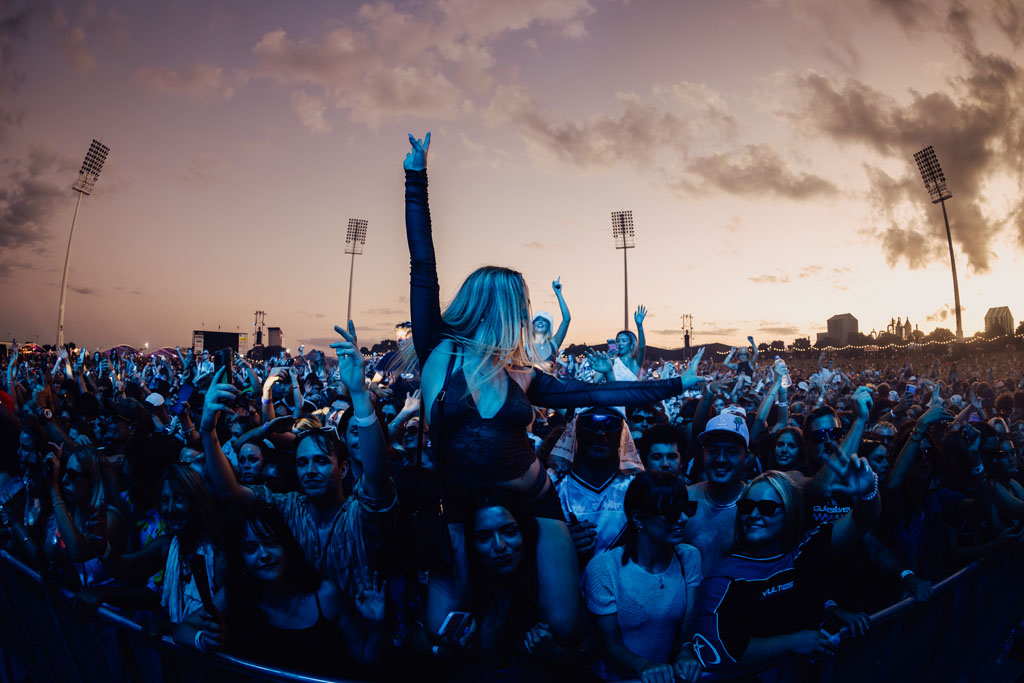
Bay Oval in Mount Maunganui sits firmly in the latter category. Best known as one of New Zealand’s premier international cricket grounds, the venue had never hosted a major live music event. That changed this summer when Australian dance music superstar FISHER drew a crowd of around 25,000 people to the coastal venue for what became the Oval’s first large‑scale concert.
For the production team behind the show, it was less about dropping a touring rig into a ready‑made venue and more about reimagining the entire site. From stage orientation and turf protection to laser safety coordination with a nearby airport, delivering a stadium‑scale dance event inside a cricket ground required months of planning and a high degree of collaboration between promoters, council, venue management and production suppliers.
The result was not just a successful show, widely credited as lifting the mood of a community still reeling from the Mount Maunganui landslides, but a clear demonstration of the potential for regional sports venues to evolve into serious live music destinations.
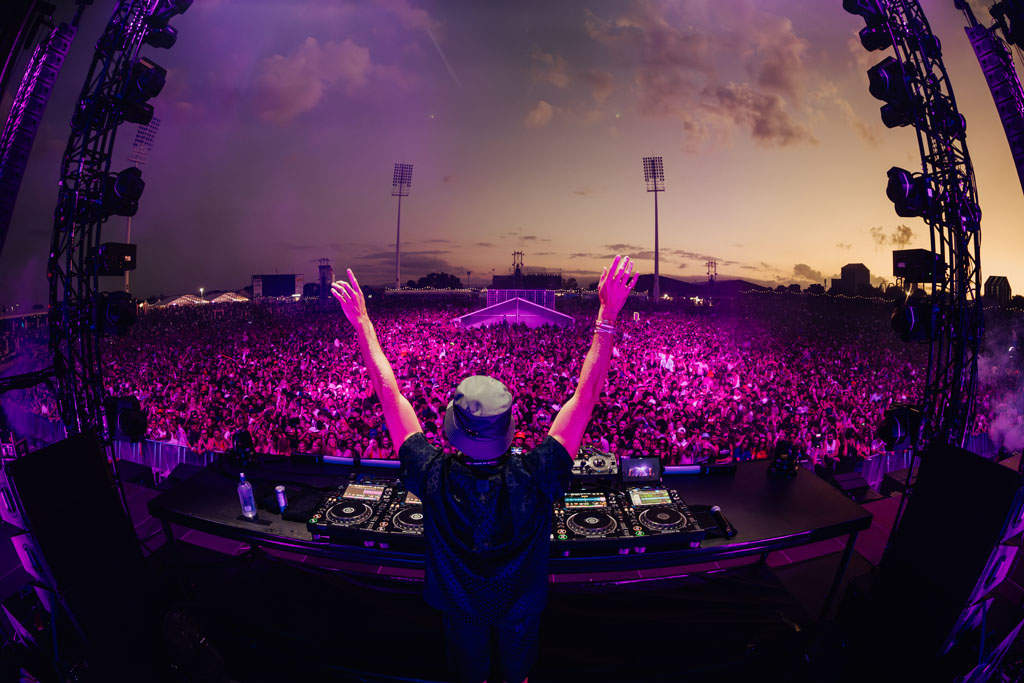
For the local council, the packed venue and the surge of visitors into the Mount’s main street afterwards reinforced the economic case for using the cricket ground to attract major touring acts to the region.
Why Bay Oval?
The idea of staging a major concert at Bay Oval had been quietly circulating for years. Trademark Live promoter Toby Burrows says the team had been in conversations with the venue for years before the opportunity finally aligned, “We’d been talking to Bay Oval for over five years about doing a show there. Working through the consents, the cricket schedules and how we would actually lay out the venue.”
Timing proved to be the final piece of the puzzle. After a successful run of shows with FISHER in Auckland and Christchurch the previous year, the artist was keen to return to New Zealand but with something different, “He’s at that stage in his career where he just wants to do really cool things, so we wanted to create something unique and iconic.”
Mount Maunganui offered exactly that. The location, the beach town atmosphere and the natural amphitheatre of the ground itself all helped sell the idea, “Being our hometown was a big part of it. The venue’s right in the Mount, it’s got the embankment, the terraced pavilion, the harbour on one side and the ocean on the other. In the middle of summer, it’s a real destination. Plus being a beach town, we thought that would appeal to FISHER, as a surfer.”
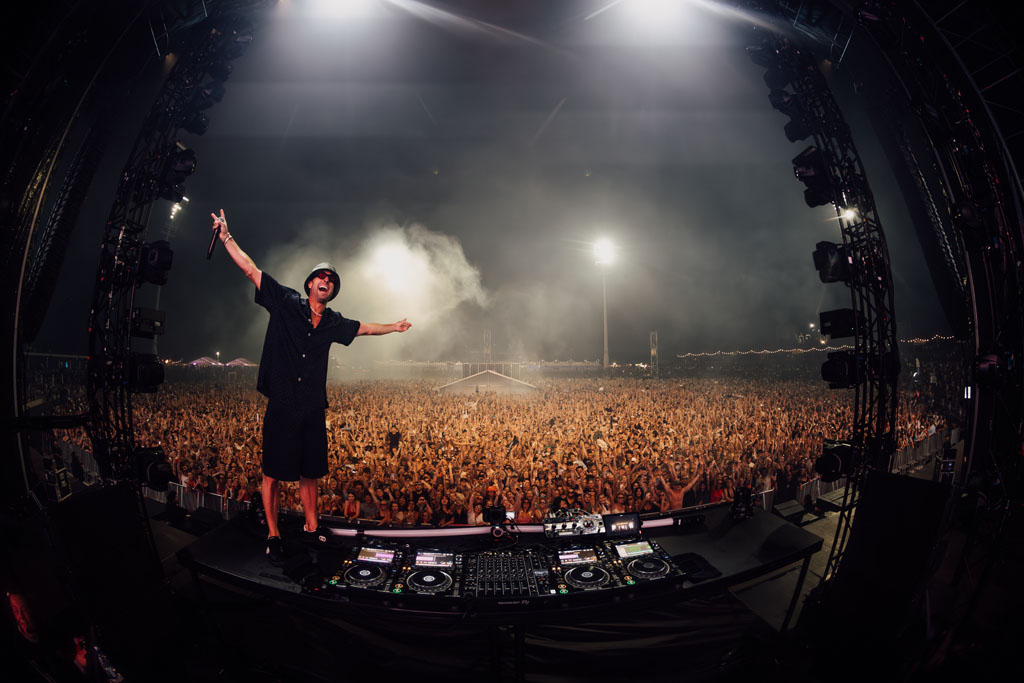
But the biggest attraction was also the biggest risk: the fact that Bay Oval had never hosted a concert before, “Being the first time the venue had ever been used for something like this, we knew it would be a challenge as well as a talking point.”
From cricket ground to concert venue
Transforming a cricket venue into a large‑scale music site presented several issues. Unlike purpose‑built stadiums or event parks, the primary function of the ground remains sport, meaning every production decision must take the playing surface into account.
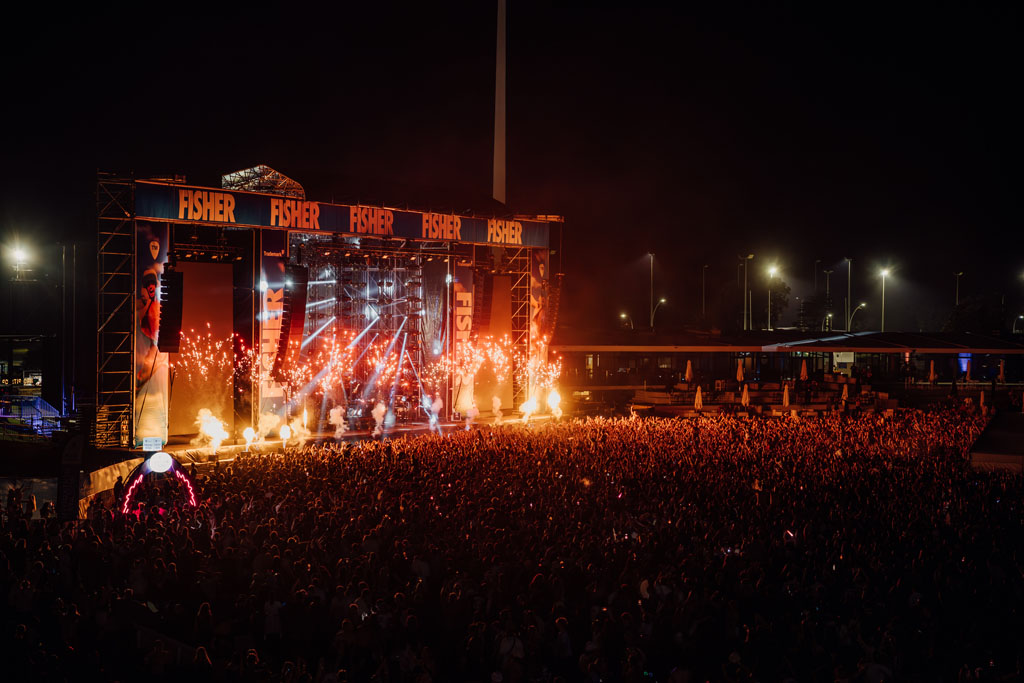
“The biggest impact on the grass is usually the stage build,” explains Burrows. “We managed to build the stage essentially into the embankment, so it wasn’t even on the playing surface.”
The solution protected the pitch while still providing a suitable sightline for the audience. Additional turf protection was installed over the wicket block, using the same style of matting commonly seen at venues such as Eden Park.
Noise management also formed a major part of the consenting process, “With residential areas nearby, noise was always the biggest potential issue. We had to go through detailed modelling to prove we could operate within the limits allowed under the consent.”
Fortunately, the venue’s natural geography worked in the production’s favour, “It provided the perfect orientation. With the stage backed up to the Mount and facing toward the harbour and industrial area, most of the sound travelled away from residential areas.”
Delivering a first‑of‑its‑kind event at the venue also required close collaboration with Tauranga City Council. Alongside the consenting process, the council’s events team worked with the promoter and venue operator Bay Oval to navigate logistics around traffic and crowd management. The city also provided financial support to help secure the event, recognising the economic and cultural value of attracting a major international act to the region.
Designing the show
Once the venue layout was resolved, attention turned to the production design. The visual concept for the show was created by Dave Eldridge of High Scream, with the New Zealand performance marking the first time the design had been deployed.
According to Chief Production Manager Johnny Gibbs, translating the touring concept into the realities of the New Zealand supply market required a considerable amount of engineering work, “The design was very challenging due to the large quantity of identical fixture types and the limited amount of any single fixture type available in New Zealand,” Gibbs explains. Marc Benedict from Forge Lighting assisted with sourcing fixtures from multiple suppliers to build the rig.
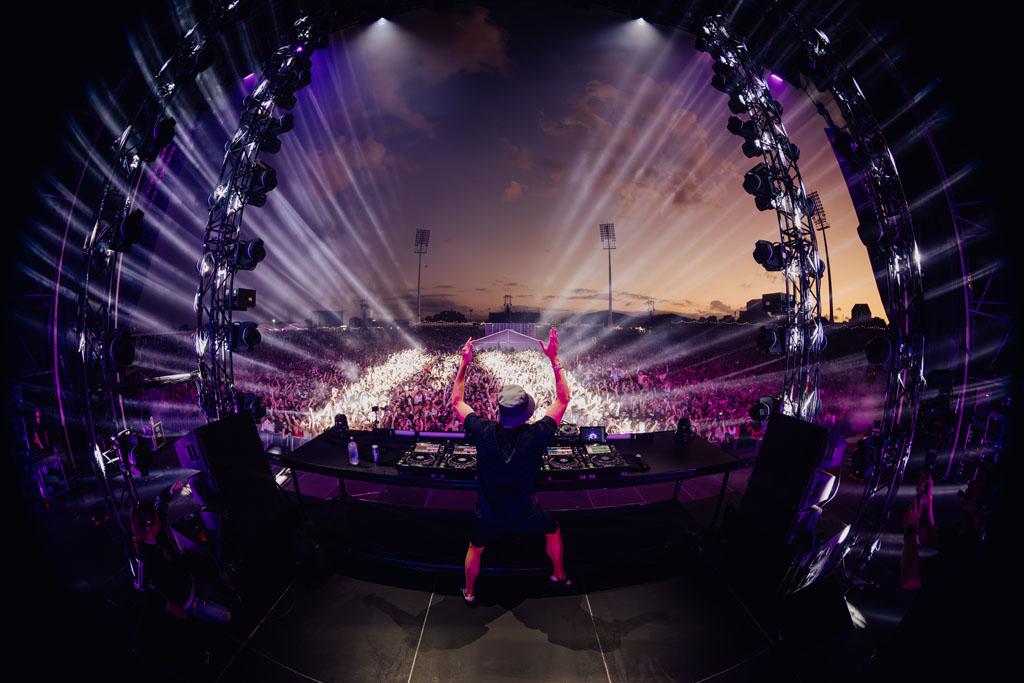
The vertical truss structures also required careful structural design. The vertical lighting trusses were carrying significant weight and were aligned beneath just two load‑bearing roof beams, which were already supporting a substantial LED configuration. To distribute the load safely, the team combined flown elements with ground-supported truss structures. Gibbs recalls, “Rocket Scaffolding CEO Dan West, their engineer and I poured many hours and late nights into the stage design. We figured out how to construct the stage on an embankment, with extra support structures in place for the ground‑supported LX trusses while also seeking to minimise any damage to even a single blade of grass on the cricket pitch, as a televised international match was scheduled soon afterward.”
Screens, lasers and control
The visual system centred around a substantial LED configuration. The upstage video wall consisted of a 7m by 9m centre screen flanked by two 4m by 9m side panels, built from Gloshine Vanish P3.9 – 7.8mm LED to reduce overall weight. Additional 6m by 9m side‑of‑stage screens constructed from Roe CB5 panels provided IMAG coverage for the large audience.
Global Production Partners supplied the main LED system and eight 40 Watt lasers used throughout the show, while CT Group supplied the sidewalls.
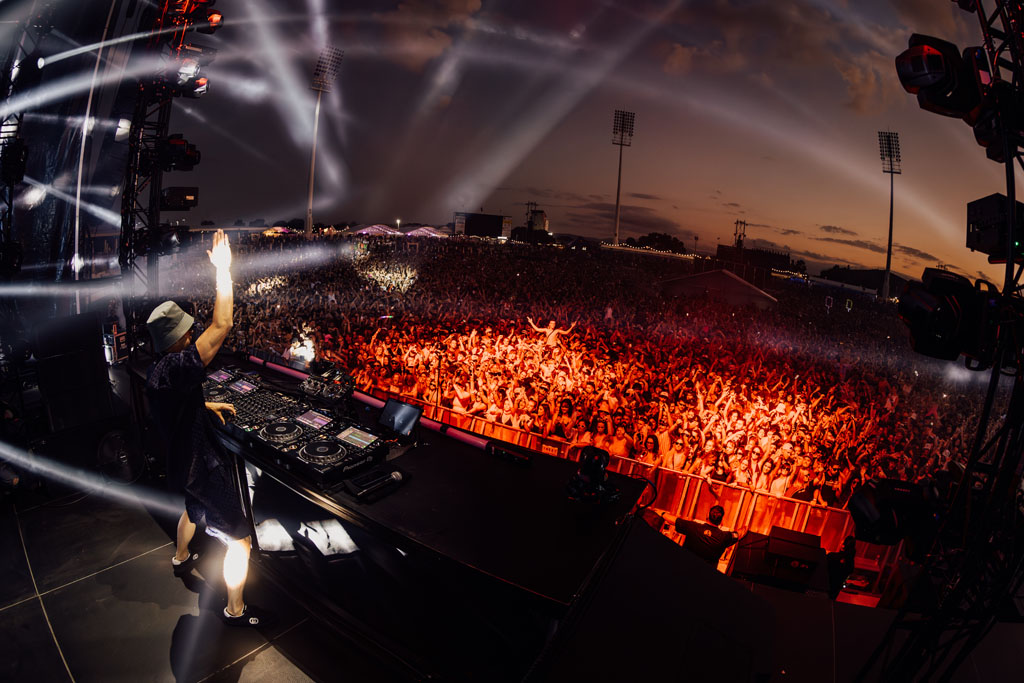
Operating lasers in Mount Maunganui required an additional layer of coordination, as Tauranga Airport lies roughly one kilometre from the site, “We had to work closely with the airport because the lasers were firing directly over the runway, implementing procedures to ensure flight operations were unaffected.”
Visual playback ran on two GX3 media servers with Pixelhue P20 handling video switching, while lighting control was managed via grandMA3 consoles.
Audio and effects
Audio for the event was supplied by Western Audio Engineering using a d&b audiotechnik system configuration. The main hangs comprised GSL8 and GSL10 arrays, supported by KSL8 side arrays and additional KSL8 and KSL12 delay towers.
Front fill coverage was provided by V7P and V10P cabinets with SL‑series subwoofers delivering the low‑frequency energy required for a dance show of this scale, “Western Audio did fantastic work on the system design to achieve an SPL suitable for the show while still enabling compliance with our noise limits for the show.”
Audio control was handled via DiGiCo SD10 and SD11 consoles. Elsewhere in the rig, Tron Audio supplied the DJ riser and equipment package including Pioneer CDJ‑3000 players and V10 and A9 mixers, and RMX1000 effects units.
LiveFX delivered flames and pyrotechnics, culminating in a 30‑second finale fired from the roof of a building behind the stage.
A lighting trick with local infrastructure
One of the more inventive production elements came from the venue itself. The Bay Oval sports lighting system is DMX‑capable, allowing individual control of the stadium lights. By linking the touring lighting system with the venue infrastructure, the team was able to integrate the floodlights directly into the show design, “This allowed the team to create special effects and powerful blinder‑style moments during the show. To my knowledge this is the first time this has been done in New Zealand and it definitely had serious impact.”
The people behind the build
As with any outdoor event, the success of the show relied heavily on the production crew working behind the scenes. Gibbs makes special mention of the FISHER production team, “They were very easy to work with and remained consummate professionals and friendly humans.”
“The key stage crew were Ryan Stechman, whom I pulled out of retirement to stage manage the show immediately after he finished his wedding, and Jono Hayes who doubled as deputy stage manager and pack‑down manager. Jono’s role was key in ensuring the turf wasn’t damaged while the packdown was in progress.”
“Overall, it was a huge effort under some real challenges, but the entire team worked wonders to make it happen. Another shoutout to the Rare Entertainment team of riggers and loaders who put in some long hours getting everything up and down, in and out.”
More than a one‑off
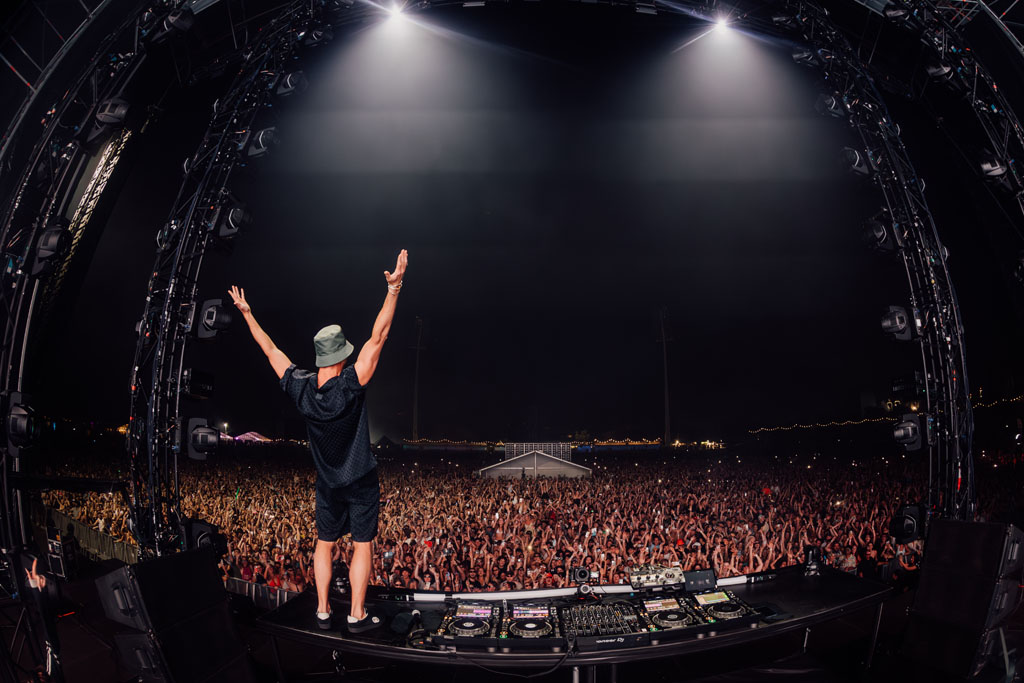
For the organisers, the successful delivery of the event demonstrated something larger than a single headline show. Burrows says the moment that stayed with him most came during FISHER’s set itself. As the performance built, a series of vertical lighting trusses flanking the DJ booth fired to life for the first time, illuminating the stage alongside the massive LED backdrop, “It was everything I hoped it would be. We’d gone through a tough time in the Mount in the week prior with the landslides, so people needed something to gather everyone together and bring some happiness to the place. When those vertical lights lit up with FISHER playing, and you had the Mount in the background, it was just incredible.”
The concert proved that regional venues, even those not traditionally associated with live music, can support major productions with the right planning and partnerships. For Bay Oval, the event has opened the door to future possibilities. And for the production teams involved, it offered the rare opportunity to turn a cricket ground into a dance floor for 25,000 people on a summer night in Mount Maunganui.
Subscribe
Published monthly since 1991, our famous AV industry magazine is free for download or pay for print. Subscribers also receive CX News, our free weekly email with the latest industry news and jobs.



Latest jobs